
Corporate team building India can measure the morning after
A great day out is easy to buy. Corporate team building India’s HR heads can defend to a CFO is harder: it starts from what the team actually struggles with, it is built as an experience rather than a games list, and it ends with commitments the team keeps. That is what we design — outbound, experiential or in-room, across six cities.
19+ years · 600+ organisations · 23 sectors · Mumbai, Bengaluru, Delhi NCR and the GCC
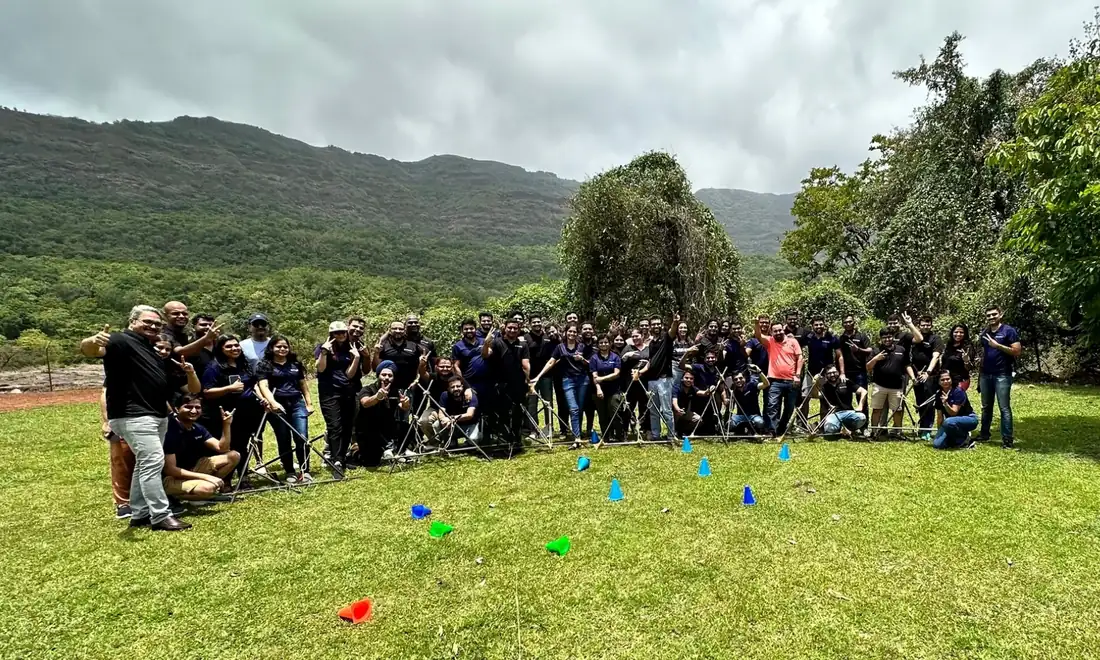
What makes team building outcome-led?
Outcome-led team building starts from a named team problem — trust, handoffs, silence in meetings, a merger of two teams — designs the experience to surface and work on that problem, and ends with commitments the team reviews a month later. The activities serve the outcome; they are never the outcome.
The research is unambiguous about what makes teams work. Google’s re:Work study of team effectiveness found psychological safety to be the strongest predictor; Katzenbach and Smith’s Discipline of Teams showed that a real team has a common purpose, shared goals and mutual accountability — not just shared memories of a rope course. Experiential team building for companies works when it is designed to build exactly those things, and debriefed into behaviour the team can keep.
A short team pulse or the Team Confidence Report™ tells us what the team actually needs before we choose a single activity.
Every outbound or experiential block is followed by a facilitated debrief that names what happened and what the team will do differently on Monday.
Commitments are written, owned and reviewed thirty days later — the part most team offsite programs India-wide leave out, and the part that makes the day worth paying for.
Three situations that bring organisations to this service
Two teams became one on an org chart six months ago and are still two teams in every meeting. The structure changed; the working relationships did not.
Delivery is fine, but problems surface late, handoffs drop, and the team has quietly stopped raising issues with each other. An outbound day that only builds energy will change nothing by Thursday.
Leadership wants the team offsite to produce more than photographs this year — a shared reset, real conversations, and commitments the team can be held to.
A games day versus an outcome-led programme
Both can be fun. Only one can be defended to a CFO afterwards. Seven design decisions separate them.
Corporate team building India-wide follows the same seven decisions whether it is outbound team building programs or in-room team development workshops — the setting changes, the design standard does not.
Six deliverables, one working team
A short pulse or the Team Confidence Report™, a conversation with the team leader, and a one-page design brief naming the outcome the day is built for.
Corporate team building India can defend: outbound team building programs, experiential team building for companies or in-room team development workshops — one to three days, sequenced so each block builds on the last.
Two facilitators for every cohort of up to forty; larger groups scale in pods, never in a crowd.
After every block: what happened, what it says about how this team works, what changes on Monday — captured, not just discussed.
The team leaves with three to five written commitments, owners and a review date — the output a team offsite should produce.
A pulse against the commitments a month later, and a short call with the team leader on what held and what needs the next push.
From brief to Monday morning in four steps
Diagnose & design
Team pulse, leader conversation, design brief. The outcome is named and the experience is built around it — outbound, experiential or in-room.
Logistics & set-up
Venue and vendor coordination in the city the team sits in, safety checks for outbound work, pre-reads for the team so the day starts at speed.
Experience & debrief
One to three days of experiential blocks, each followed by a facilitated debrief; the final session turns the learning into written commitments and a team charter.
Pulse & follow-through
The same questions, a month later; a short call with the team leader; and, where the team wants sustained change, a path into Results Driven Teams™.
What changes for the business, the team leader, the team — and the customers they serve
Team building that is designed for an outcome changes more than the mood on the bus home. This is what it looks like, seat by seat.
Teams that trust each other and raise problems early deliver faster and escalate less. The before-and-after reads give the sponsor evidence that the spend did something — which is how the next programme gets approved without a fight.
Watch: before-and-after team reads, escalations to the sponsorThe hardest conversations — about trust, silence, who drops the handoffs — happen in a designed space with a neutral facilitator, and come back as commitments the leader can hold the team to rather than grievances they have to manage.
Watch: commitments kept at day 30, one-to-one qualityTwo teams become one in practice, not just on paper; the quiet members speak; the handoffs that kept dropping get named and fixed. People leave knowing something true about each other and something specific they will do differently.
Watch: psychological-safety read, handoff defectsMost customer-facing failures are handoff failures between teams that do not talk. A team that raises problems early and owns its handoffs is a team whose customers stop noticing the seams.
Watch: cross-team issue resolution time, repeat escalationsWhat this work has delivered for clients
Outcome-led team building is accountable to the thirty-day pulse. Until the first measured case is published, here is the scale of the team and offsite work already on the record.
Evidence standard: delivered at scale. Business figures are the client’s own; our work ran alongside them, and we say so. The full write-ups, with situation, what we did and why it worked, are on the case studies page.
Cities we deliver in
Where we work: corporate team building India-wide, with team building Mumbai organisations run within a day’s drive, team building Pune teams take to Mulshi, outbound training India’s manufacturers take to the hills, outbound team building Hyderabad and experiential learning Bengaluru capability centres schedule between release cycles, team building Chennai and team building Delhi head offices can book in a single call — from a corporate team building company India’s HR heads can hold to a thirty-day pulse. Team building activities for corporates are designed per team; a team building program India-wide follows one standard.
At a glance
Enquire about this service
Tell us what this team struggles with — a senior practitioner replies within one working day. No sales sequence, no juniors.
We use these details only to respond to your enquiry. We don't share them or add you to a mailing list. See our Privacy Policy.
Corporate team building, asked the way buyers ask it
Is this outbound, experiential or indoor team building?
Any of the three, chosen by the outcome and the team, not by the catalogue. Outbound team building programs suit trust and resilience work; experiential blocks suit communication and decision-making; in-room team development workshops suit teams that need hard conversations more than adventure. Many programmes combine two.
Which cities do you deliver corporate team building in?
Mumbai, Pune, Bengaluru, Hyderabad, Chennai and Delhi NCR, with vetted venues within a few hours of each — Lonavala and Karjat from Mumbai, Mulshi from Pune, Coorg and Nandi Hills from Bengaluru, and so on. The same facilitators and the same design standard travel to every city, and we deliver elsewhere in India on request.
How is this different from a senior-team strategy offsite?
A leadership retreat is for a senior team working on strategy and decisions; this is for intact teams working on how they work together. If your need is the senior team's strategy, our Leadership Retreats & Workshops page is the right door; if it is a team that has stopped trusting each other, you are in the right place.
What group sizes work?
Twelve to forty per cohort for serious corporate team building India-style — real work, two senior facilitators.. Larger events — a 400-person function offsite — are designed in pods of thirty to forty that run the same experience in parallel and come together for the debrief, so nobody is a spectator.
What happens after the programme?
The team leaves with written commitments and a review date; thirty days later we run the same pulse and talk to the team leader about what held. Teams that want sustained change move into Results Driven Teams™, a quarter-long programme that builds on the same diagnostic.
How is a team building programme priced?
Fixed-fee for corporate team building India-wide — design, facilitation, debriefs and the thirty-day pulse — quoted after the design brief; venue, travel and outbound vendor costs pass through at cost, with options at different price points in each city. You see the whole number before you commit.
Ready to build a team, not just a memory?
Start with the team pulse — the way corporate team building India’s best HR teams begin. It tells us what this team actually needs, and whether a day, three days or a full quarter is the honest answer.