
The Organizational Effectiveness Inventory®: the levers behind your culture, and what it costs you
The Organizational Effectiveness Inventory measures the two things a culture profile cannot, namely the internal conditions that shape your culture and the outcomes that culture produces. Specifically, ours is the Human Synergistics® OEI, a 128-question survey that takes about 20 minutes. First your people describe the structures, systems, technologies and skills around them, then the report sets outcomes at individual, group and organisational level against benchmarks, and after that an accredited practitioner reads the levers with you. As a result, culture change gets a cause, not just a symptom.
19+ years · 600+ organisations · 23 sectors · Senior practitioners only, since 2007
Where the OEI sits in the culture chain
The OEI reads the levers that shape your culture and the outcomes it produces. The OCI measures the culture in between.
What is the Organizational Effectiveness Inventory?
The OEI full form is Organizational Effectiveness Inventory, a 128-question diagnostic that measures the internal conditions shaping an organisation's culture, namely its structures, systems, technologies and skills, and the outcomes that culture produces at individual, group and organisational level.
An engagement survey gives you one organisational mood. By contrast, the organisational effectiveness survey reads three levels, namely individual engagement, satisfaction and stress, group teamwork and coordination, and organisational adaptability and quality, and it names the causal factors behind each. In short, it is the research-based alternative to the attitude survey, and it can also bring meaning to engagement results you already have.
Developed by Dr Robert A. Cooke and published by Human Synergistics International, the OEI survey is the companion to the culture profile. So where the OCI shows what the operating culture is, the OEI shows why it reads that way and what it is costing you. Run together, the combined feedback report ties norms, levers and outcomes into one evidence base. Also, Seven delivers the Human Synergistics OEI India wide through accredited practitioners, which is why the Human Synergistics OEI India clients commission is debriefed, never dropped.
Structures, systems, technologies and skills at organisation, team and job level. In other words, these are the levers leadership can actually pull.
Individual engagement, motivation and stress, group teamwork and coordination, and organisational adaptability and quality. Together, these show what the culture is producing.
Finally, results are compared with historical averages from over 700 organisations and with Constructive benchmarks from about 120 organisations with healthy cultures.
How culture works, and where each Human Synergistics instrument measures it
Culture does not stand alone, because it sits between your ideal and the results you get. So the model links four things: the culture you want, the causal factors behind it, the culture people actually experience, and the outcomes it produces.
Swipe sideways to see the full model.
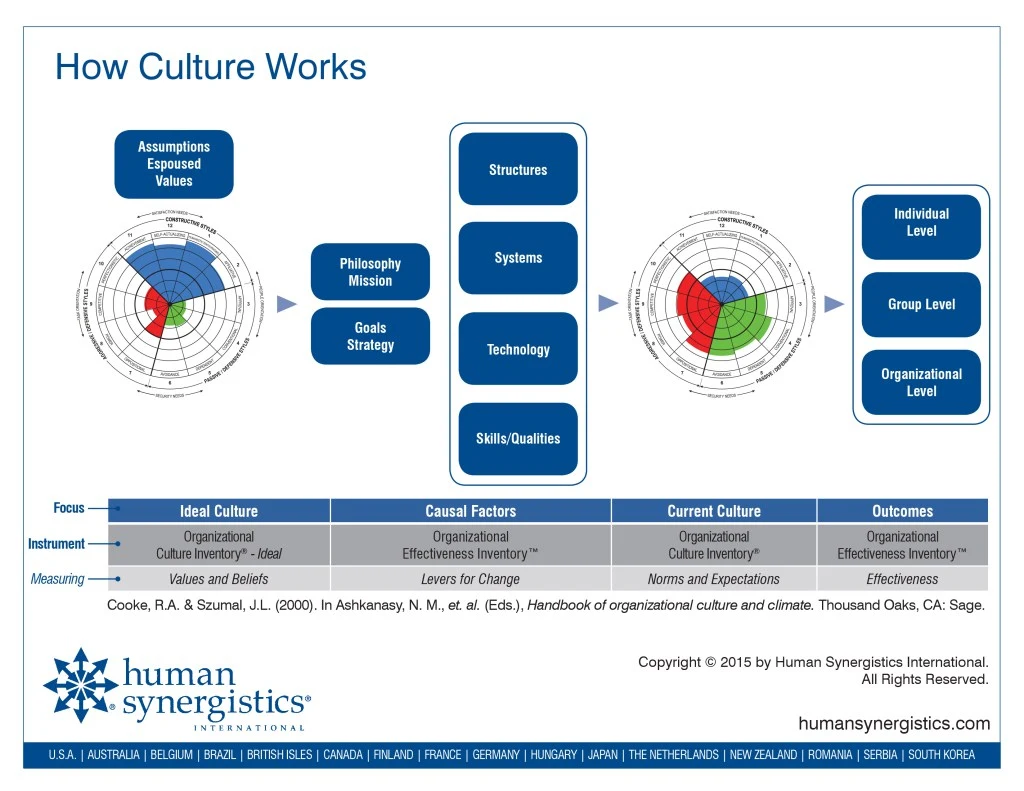
The OCI measures ideal and current culture, while the OEI measures the causal factors and the outcomes.
Three situations that bring organisations to the OEI
The survey says 62 per cent engaged, yet nobody can say why, or what to change. So a culture levers and outcomes assessment reads the conditions behind the score, and the levers come with it. In short, the culture levers and outcomes assessment turns a number into a plan.
You have measured the culture, so the gap to the ideal is clear. However, a profile alone does not say which structures, systems and skills are reinforcing the norms. The OEI answers that question, so the change plan targets causes.
A transformation has run for a year, and now leadership wants to know what moved. Because the OEI measures outcomes against benchmarks, a re-measure shows the effect of the programme, not just the activity.
The OEI is the measurement. When the levers become a change programme, that work runs through our culture change management practice, and this page stays focused on the instrument.
What an Organizational Effectiveness Inventory report measures
Human Synergistics places the OEI on both sides of the operating culture, so the report reads the causes first and the effects second.
Causal factors
The levers, at three levels
Organisation level: Mission and philosophy, structures, systems such as selection, training, appraisal and reward, and the technology people work with.
Team level: How work groups are organised, how decisions involve people and, equally, how coordination and communication run between units.
Job level: Job design, autonomy, feedback, goal clarity and the quality of supervision, because that is where most people feel the culture daily.
Outcomes
The effects, at three levels
Individual: Engagement, motivation, satisfaction and stress, so you see what the culture does to each person.
Group: Teamwork, coordination and, likewise, the quality of working relationships between and within units.
Organisational: Adaptability, external focus and the overall quality of products and services, which is where culture reaches the customer.
The combined OCI and OEI report
When the OEI runs alongside the culture survey, Human Synergistics produces one combined feedback report. First, it presents the current operating culture. Then it shows the impact of that culture on outcomes and the internal factors reinforcing it, with correlations between the norms and the OEI measures. Therefore the levers for change are not guessed, because they are shown.
Measures and levels follow Human Synergistics' published product information, so read the full description in the OEI product information sheet. Also, OEI® and OCI® are registered marks of Human Synergistics International.
The engagement survey versus the effectiveness inventory
Engagement tells you how people feel. The OEI assessment tells you what is producing that feeling and what it is costing, so the two are not interchangeable.
In fact, Human Synergistics positions the OEI as a replacement for the traditional attitude survey, or as the instrument that brings meaning to engagement results. Either way works.
Six deliverables in every Organizational Effectiveness Inventory deployment
The 128-question core, plus up to 40 custom questions, so the deployment carries your organisation's specific priorities alongside the licensor's research-grade core.
Online, confidential, about 20 minutes per person. Then responses are aggregated and analysed, so no individual is ever singled out.
Causal factors and outcomes set against historical averages and Constructive benchmarks. Also, results are available by division, department or office.
Findings are interpreted with leadership and the change team by an accredited practitioner, so the OEI is never delivered as a report drop.
When the OCI runs alongside, one combined report ties norms, levers and outcomes together. As a result, the change agenda targets causes.
The OEI runs again after the intervention, so the effect on outcomes is demonstrated rather than asserted.
From unexplained scores to named levers
Brief and design
We start with the question in front of you, such as an unexplained engagement score or a culture gap that needs a cause. Then we design the custom questions and the subgroup cuts before a single link is sent.
Survey
The OEI runs online across the organisation, or alongside the culture survey, in about 20 minutes per person. After that, reports generate against the benchmarks.
Read the levers
Next comes the accredited practitioner readout with leadership. The outcomes show the cost, the causal factors show the levers and, finally, the combined report links both to the culture.
Act and re-measure
The levers become the change agenda. After that, the OEI runs again, so the movement in outcomes is demonstrated on the same instrument.
What changes for leadership, HR, managers and the change programme
An Organizational Effectiveness Inventory pays for itself when the levers get pulled, so here is the change seat by seat.
The OEI documents the need for change in outcomes a board recognises, such as teamwork, adaptability and quality. So the culture conversation starts from cost, not adjectives.
An OD diagnostic survey Mumbai or Bengaluru HR teams can defend shows which systems and structures to change first. As a result, the intervention budget goes where the data says.
Because the OEI reads job design, feedback, goal clarity and supervision, managers see what their own team experiences. Then the fixes are local and specific.
Human Synergistics built the OEI, in part, to monitor the impact of change initiatives. Therefore a culture outcomes measurement India wide, before and after, shows what the programme actually moved.
Where the OEI gets applied
One instrument, eight working contexts, because the same organisational effectiveness survey can be aimed at different decisions.
The OEI assessment stands alone as the research-based alternative, so the annual survey finally comes with causes attached.
Run it beside the engagement survey you already have, so the effectiveness diagnostic for companies brings meaning to the score.
Paired with the OCI, the combined report names the levers, so our culture change management work starts from them.
Outcomes against benchmarks give leadership the need and, above all, the case for improvement in numbers.
Targets for the organisation, as well as for teams and subunits, come straight from the subgroup results.
The levers of culture change survey runs again after the programme, so impact is monitored rather than assumed.
Individual outcomes include motivation and stress, so wellbeing work gets a measured baseline.
When results point at leadership, a 360 degree feedback round follows, which is the pairing Human Synergistics recommends.
What the Human Synergistics OEI stands on
A culture causal factors assessment should rest on what the publisher actually claims, so we repeat Human Synergistics' position and its limits here. Then you can judge the instrument before you buy.
What this gives you
- A 128-question instrument developed by Dr Robert A. Cooke, as well as historical averages from over 700 organisations and Constructive benchmarks from about 120 organisations with healthy cultures.
- Outcomes and causal factors measured together, so the report shows both the cost of the culture and the levers for changing it.
- Results by subgroup, such as divisions, departments or offices, so targets can be set where they apply.
- Also, it pairs with the culture survey in one combined report, with correlations between the norms and the OEI measures.
What it does not tell you
The OEI measures climate, namely perceptions and attitudes about conditions and outcomes. However, it does not measure the behavioural norms themselves, which is the culture survey's job. For that reason, Human Synergistics recommends running the two in tandem.
It is also an aggregated instrument, so it describes units and the organisation, never individuals. Every readout is therefore debriefed by an accredited practitioner, and Human Synergistics licenses the OEI only to accredited practitioners.
Positions as published by Human Synergistics on its OEI page, its product information sheet and its research and publications library.
OEI downloads and reference material
Read the licensor's own documentation before you commit. Also, each link opens in a new tab on the Human Synergistics site.
An accredited OEI practitioner India leaders have worked with since 2007
Founder and MD, Seven People Systems
- Human Synergistics accredited practice, for the OEI, OCI and GSI
- ICF Associate Certified Coach (ACC)
- TTI Success Insights partner and AQai Certified Coach
Because Seven's OEI engagements are led by Nikhil and delivered with accredited practitioners, every Organizational Effectiveness Inventory readout is debriefed by a senior person, never a junior. Read more on Nikhil's profile.
The OEI is the causal half of the diagnostic beneath our culture and transformation engagements, so see what changed, and for whom, in our client work.
Where we run it
The survey is online, so location rarely limits you. Readouts then run in person or by video, and a deployment usually completes within four weeks. When leaders want the full picture, they pair the OEI with the OCI, the GSI for intact teams, or our HR analytics work for the numbers behind it. Afterwards, the change programme itself runs through our culture and employee experience practice.
At a glance
Enquire about the Organizational Effectiveness Inventory
Once you tell us which scores you cannot explain, an accredited practitioner replies within one working day. Also, there is no sales sequence and no junior hand-off.
We use these details only to respond to your enquiry. We don't share them or add you to a mailing list. See our Privacy Policy.
The Organizational Effectiveness Inventory, asked straight
What is the OEI full form, and what does it measure?
The OEI full form is Organizational Effectiveness Inventory, and for anyone asking what is OEI in HR, it is a 128-question diagnostic from Human Synergistics, developed by Dr Robert A. Cooke. The OEI meaning is simple: it measures the internal conditions that shape an organisation's culture, namely structures, systems, technologies and skills, and the outcomes that culture produces at individual, group and organisational level. In short, it reads the levers and the effects on either side of the culture itself.
How is the OEI different from our engagement survey?
An engagement survey measures sentiment, whereas the OEI measures the conditions producing it and the outcomes flowing from it. Where engagement gives you one organisational average, the organisational effectiveness survey reads three levels, namely individual engagement and stress, group teamwork, and organisational adaptability and quality, and it names the causal factors behind each. So keep the engagement survey, because the OEI explains its score.
Do we need to run the culture survey first?
No. The OEI stands alone, and many organisations start with it precisely because it points directly at actionable levers. However, the pairing is where the full power sits. Run both, then the combined feedback report integrates norms, causes and outcomes into one evidence base, with correlations between the two. That is the complete how-culture-works chain, measured end to end.
What does the OEI survey involve for our people?
About 20 minutes, online on any device, and completely confidential, because responses are aggregated and no individual is ever singled out. The base instrument is 128 validated questions. Also, up to 40 custom questions can be added, so the deployment carries your organisation's specific priorities alongside the licensor's research-grade core.
What are the benchmarks?
First, Human Synergistics compares your results with historical averages based on over 700 organisations, and with Constructive benchmarks based on about 120 organisations with healthy cultures. Results can also be presented by subgroup, such as divisions, departments or offices. As a result, a culture levers and outcomes assessment shows not only where you stand but where the healthy cultures stand.
Who can administer and interpret the OEI?
Only accredited practitioners, because Human Synergistics requires accreditation before OEI materials can be purchased. Also, that accreditation programme is pre-approved for ICF continuing coach education units and HRCI recertification credit. Seven People Systems is an accredited OEI practitioner India organisations have used since 2007, so every Human Synergistics OEI India deployment we run includes the accredited debrief, with findings interpreted with leadership rather than dropped as a report.
Can the OEI monitor whether a change programme worked?
Yes, and in fact Human Synergistics lists that as a core application. Because the OEI measures outcomes against benchmarks, running it before and after an initiative shows what moved at individual, group and organisational level. Therefore a culture outcomes measurement India wide becomes the proof that a transformation changed conditions, not just activity.
How is the OEI priced?
Pricing follows deployment scope, namely population size, custom-question design, and whether the combined report with the culture survey is included. Licensor survey fees are passed through transparently, while the accredited readout is always part of the engagement. We quote a fixed fee after the context brief, so the full cost is known before any survey link goes out.
Find the levers before you pull them
Start with a context brief, because an Organizational Effectiveness Inventory deployment should begin with the score you cannot explain named first, the survey design second, and an accredited debrief on every readout.