
The Group Styles Inventory™: how your team actually works together, measured
The Group Styles Inventory measures how a team's members interact while they solve a real problem together, which is the thing offsites keep trying to change without measuring. Ours is the Human Synergistics® GSI, completed by each member in about 15 minutes immediately after the team works a task. First the team solves the problem, then each person describes how the group behaved, and after that the aggregated profile lands on the Circumplex. As a result, the team sees its own pattern, and a second round shows whether it changed.
19+ years · 600+ organisations · 23 sectors · Senior practitioners only, since 2007
What the GSI profile shows
Drawn from profiles of 31 groups that completed a Human Synergistics problem-solving simulation.
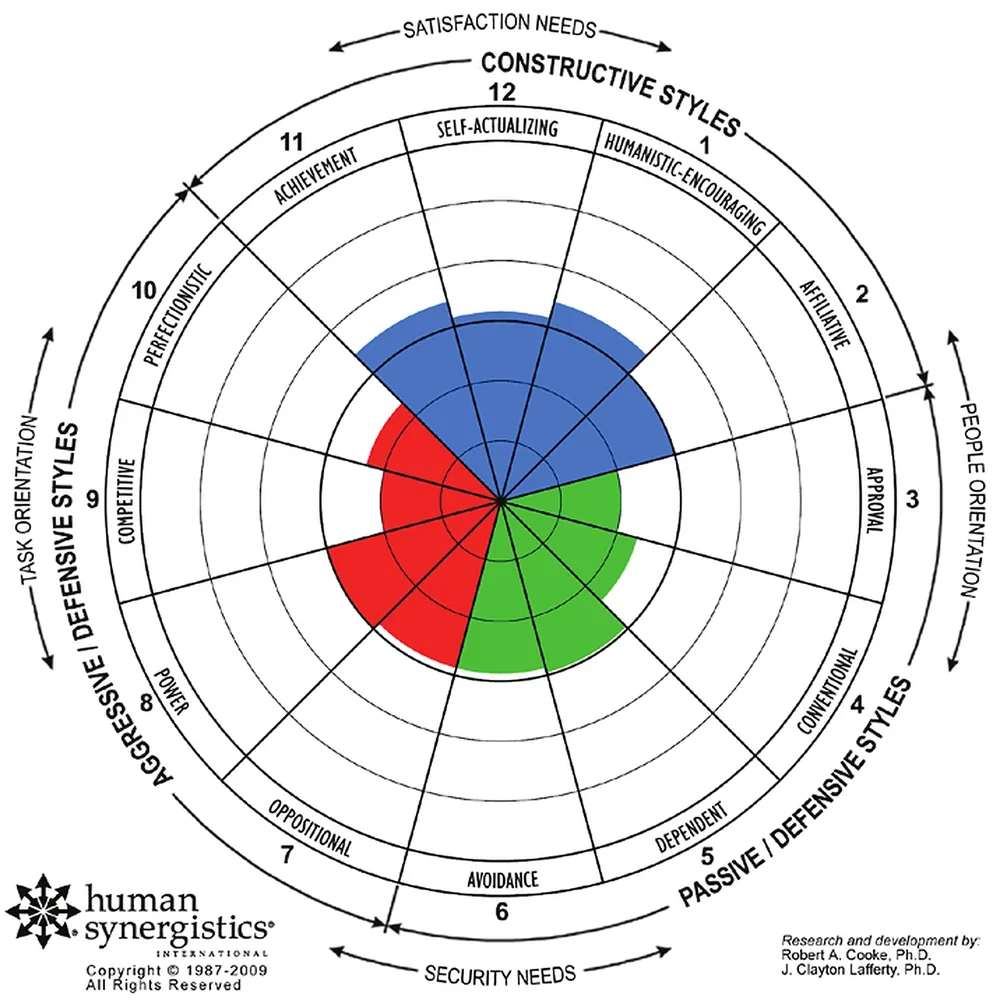
The 10 groups that performed effectively were predominantly Constructive.
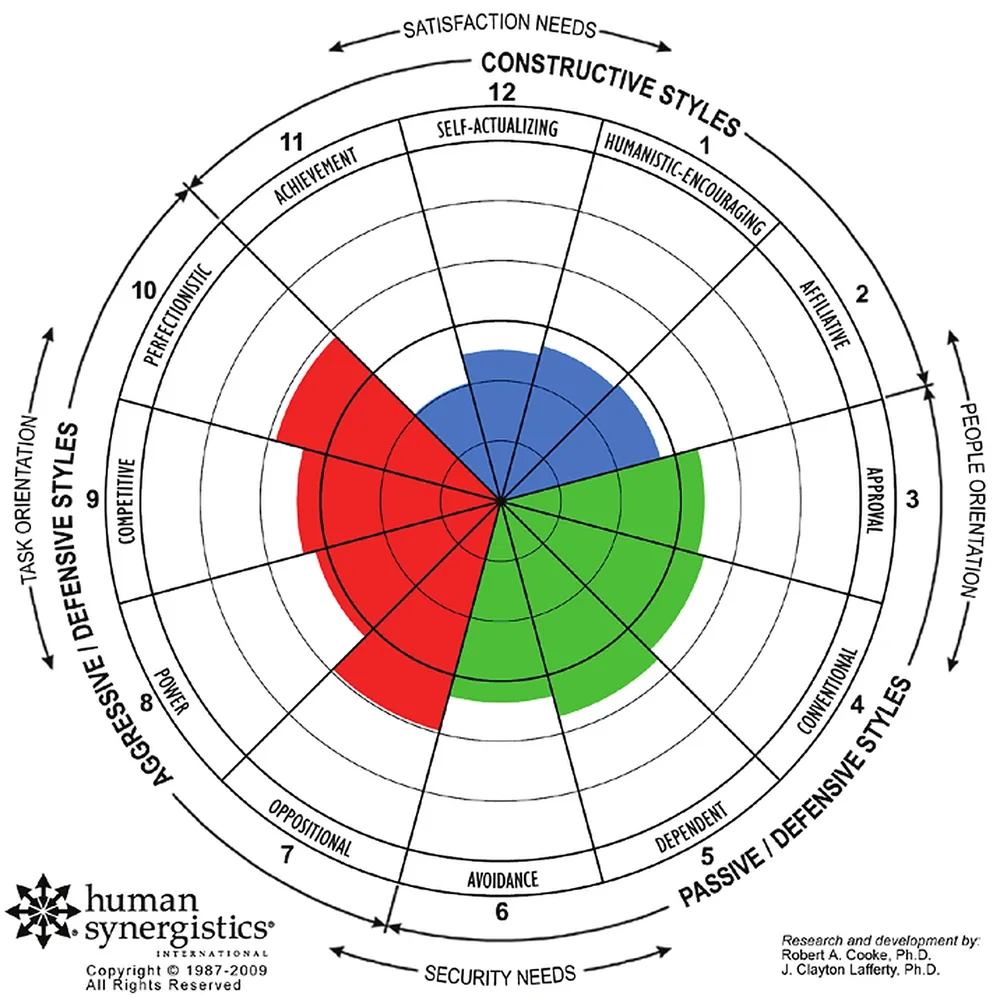
The 21 groups that performed less effectively showed both Passive/Defensive and Aggressive/Defensive styles.
What is the Group Styles Inventory?
The Group Styles Inventory is the only research-based instrument that measures how a group's members actually interact while working together. Each member completes it immediately after the team solves a real problem or a simulation, and the responses aggregate onto the Circumplex across twelve styles. So it measures the process, not the product, namely the way the answer was reached.
That distinction matters, because research links the way a group interacts directly to how good its solution is and whether anyone commits to it. A team interaction styles assessment therefore gives teams the mirror survey data cannot, since it captures not opinions about the team in general but members' own read of what just happened in the room.
Developed by Dr Robert A. Cooke and Dr J. Clayton Lafferty and published by Human Synergistics International, the GSI assessment uses the same twelve styles as the Human Synergistics culture and individual instruments, so a group profile sits beside its organisation's culture profile on one model. Also, Seven delivers the GSI team assessment India wide through accredited practitioners, usually around a problem the team is actually facing.
Achievement, Self-Actualizing, Humanistic-Encouraging and Affiliative. These facilitate high-quality problem solving and decision making.
Four Passive/Defensive and four Aggressive/Defensive. These detract from effective performance, so the profile shows which ones the team leans on.
Team effectiveness, solution acceptance, solution quality and synergy, so the styles sit beside the result they produced.
Three teams that need a team interaction styles assessment
Meetings end in consensus, yet decisions unravel in the corridor. In fact, the GSI usually shows Approval and Dependent styles doing the agreeing, so the real debate never happened.
Capable people, poor solutions, and the same person deciding every time. Because the GSI measures Power and Competitive styles as the group experienced them, the pattern becomes discussable without blame.
You are investing in team development and want proof it worked. So the GSI runs before the intervention and again after, and the two profiles show what moved.
The GSI is the measurement. For intact teams that want a full programme built on it, that work runs through our Results Driven Teams™ offer, and this page stays focused on the instrument.
The twelve styles a Group Styles Inventory profile shows
The GSI reports the same twelve styles as the rest of the Human Synergistics model, yet it reads them at group level, so each one describes how the team behaved while it worked. Then explore them on the interactive Circumplex below.
Constructive
Styles that produce better solutions
Achievement: The group set clear goals, then pursued them with energy.
Self-Actualizing: Members thought creatively and, above all, enjoyed the work.
Humanistic-Encouraging: Members supported one another and built on each other's ideas.
Affiliative: The group stayed friendly, open and, equally, cooperative.
Passive/Defensive
Styles that protect people, so they cost the solution
Approval: Members agreed in order to be liked, so disagreement went unspoken.
Conventional: The group played it safe and stuck to the rules, even when they did not fit.
Dependent: Members waited for someone else to decide, hence the loudest voice led.
Avoidance: Members held back, so nobody owned the answer.
Aggressive/Defensive
Styles that protect status, so they cost the group
Oppositional: Members criticised ideas rather than improving them.
Power: One or two people controlled the discussion, while others yielded.
Competitive: Members tried to win the argument instead of solving the problem.
Perfectionistic: The group chased detail, so time ran out before the decision.
Why the styles predict the solution
Human Synergistics illustrates the link with 31 groups that completed one of its problem-solving simulations. The ten groups that performed effectively were all predominantly Constructive in their interaction style, whereas the 21 less effective groups showed Passive/Defensive and Aggressive/Defensive styles. In other words, how teams interact decides how good their answer is.
Style names and descriptions follow Human Synergistics, so read the full description in the GSI product information sheet. Group Styles Inventory™ and the Circumplex are marks of Human Synergistics International.
The GSI Circumplex, style by style
Hover over any of the twelve styles, or tap one on a phone, and the card shows how a group behaves when that style leads. Because the Group Styles Inventory profiles your team on exactly this model, this is the map every GSI debrief is drawn on.
Achievement
Style 11 of 12The group set clear, challenging but realistic goals and pursued them with energy, so the problem got solved.
Hover or tap a style on the wheel to read how a group shows it.
Circumplex®, style names and style descriptions © Human Synergistics International, research and development by Robert A. Cooke, Ph.D. and J. Clayton Lafferty, Ph.D. Reproduced by Seven People Systems as an accredited practitioner. Read the original on the Human Synergistics GSI page.
The team survey versus a group dynamics measurement tool
A team survey asks how people feel about the team. The GSI asks what the team just did, so a how teams interact assessment and a satisfaction survey are not interchangeable.
Human Synergistics describes the GSI as a safe way for members to talk about their behaviour and how it affects the group's performance. That safety is the point.
Six deliverables in every Group Styles Inventory engagement
A Human Synergistics simulation or a live problem the team is actually facing, so the behaviour measured is real.
72 statements plus the outcome questions, completed by each member in about 15 minutes immediately after the task. Then results are aggregated into the group profile.
The team's styles on the Circumplex, with individual perceptions beside the combined picture, so differences in how members saw the room are visible too.
The team reads its own profile with an accredited practitioner, so the conversation is about behaviour and the solution, never about blame.
The team names the styles it will use more and less, and writes its own agreements, which is what makes the second round different.
The GSI runs again after the intervention, on the same instrument, so the change in interaction and in solution quality is shown rather than felt.
From one task to a measured change in how the team works
Brief and choose the task
We start with the team and the decision it struggles with. Then we pick the simulation or the live problem that will surface the real pattern.
Work, then measure
The team solves the problem together. Immediately after, each member completes the GSI in about 15 minutes, and the profile is generated.
Debrief and agree
Next, the accredited practitioner walks the team through its own profile. The team then names the styles to change and writes its working agreements.
Intervene and re-measure
After the development work, the team works a second task and completes the GSI again. As a result, the before-and-after profiles show what moved.
What changes for the team, its leader, HR and the organisation
A Group Styles Inventory pays for itself when the next decision is reached differently, so here is the change seat by seat.
Because the profile describes the group and not any one person, members can say what happened in the room without blame. Then the working agreements are theirs, not the facilitator's.
A GSI for leadership teams shows a leader whether the team agrees because it is convinced or because it is deferring. As a result, the leader can change how the room runs.
Team dynamics measurement Mumbai or Bengaluru HR teams can defend comes from two rounds on the same instrument. So the investment in a team shows a measured return.
Since the GSI shares the twelve styles with the culture inventory, group interaction and organisational norms can be read together. So the group dynamics measurement tool becomes part of the culture story, and measuring group process stops being a one-off.
Where the GSI gets applied
One instrument, eight working contexts. The same group dynamics measurement tool, aimed at different teams.
Measure and monitor how a team performs on problem solving, because the outcome questions sit beside the styles.
A GSI survey Mumbai or Delhi NCR leadership teams run at the start of a leadership retreat, so the retreat works on the real pattern.
Develop the consensus and problem-solving skills of individual contributors, which Human Synergistics lists as a core use.
Create a team environment that encourages innovation, since Defensive styles are what suppress ideas.
The before-and-after baseline inside Results Driven Teams™, so the programme is measured at both ends.
Temporary groups responsible for a decision, measured mid-way through the problem so they can practise better interaction on it.
Paired with the OCI, group interaction and organisational norms read on one model, so culture change reaches the team.
Run with the Human Synergistics survival or business simulations, so the task is engaging and the data is comparable.
What the Human Synergistics GSI stands on
A group dynamics assessment India teams rely on should rest on what the publisher actually claims, so we repeat Human Synergistics' position and its limits here. Then you can judge the instrument before you buy.
What this gives you
- Human Synergistics describes the GSI as the only research-based tool that provides a valid and reliable measure of how people in groups interact to solve problems.
- Published research showing effective groups were predominantly Constructive, while less effective groups showed Defensive styles.
- Both individual and aggregated profiles, so each member sees their own read of the group beside the combined one.
- Also, it is available in more than 30 languages, and it pairs with the Human Synergistics culture and individual instruments on one model.
What it does not tell you
The GSI measures how the group interacted on one task, so it is a snapshot of process, not a verdict on the team or on any individual. That is why it is read with an accredited practitioner and repeated after the intervention.
It also does not measure the organisation's norms or an individual's style. For those, Human Synergistics recommends the culture inventory and the Life Styles Inventory alongside it.
Positions as published by Human Synergistics on its GSI page, its product information sheet and its research and publications library.
GSI downloads and Circumplex background
Read the licensor's own documentation before you commit. Also, each link opens in a new tab on the Human Synergistics site.
An accredited GSI practitioner on every team session since 2007
Founder and MD, Seven People Systems
- Human Synergistics accredited practice, for the GSI, OCI and OEI
- ICF Associate Certified Coach (ACC)
- TTI Success Insights partner and AQai Certified Coach
Because Seven's GSI sessions are led by Nikhil and delivered with accredited practitioners, every Group Styles Inventory debrief is run by a senior person, never a junior. Read more on Nikhil's profile.
The GSI is the diagnostic beneath our intact-team work, so see what changed, and for whom, in our client work.
Where we run it
The GSI works best in the room, because the team solves the task together first, so most sessions run in person in Mumbai, Bengaluru, Delhi NCR, Pune or Hyderabad, and online where a team is distributed. When leaders want a wider picture, they pair the Human Synergistics group styles data with the OCI for the organisation, the OEI for the levers, or Lens360 AI™ for individual leaders. Afterwards, intact teams that want a full programme continue into Results Driven Teams™.
At a glance
Enquire about the Group Styles Inventory
Once you tell us which team and which decision, an accredited practitioner replies within one working day. Also, there is no sales sequence and no junior hand-off.
We use these details only to respond to your enquiry. We don't share them or add you to a mailing list. See our Privacy Policy.
The Group Styles Inventory, asked straight
What does the Group Styles Inventory actually measure?
It measures how the members of a group interacted with one another while solving a problem together, which is the process rather than the product. Each member responds to 72 statements describing the styles the group showed, plus a few questions on effectiveness, solution acceptance, solution quality and synergy. Then the responses aggregate onto the Human Synergistics Circumplex across twelve styles, four Constructive and eight Defensive.
How is a GSI assessment different from a team survey?
A team survey asks how people feel about the team in general, from memory. The GSI assessment, by contrast, asks what the team just did on a task it completed minutes earlier, so recall is fresh and the styles sit beside the solution they produced. In short, one measures sentiment, while the other measures interaction.
When do team members complete the GSI?
Either immediately after the team has solved a problem, to identify the behaviours that helped or hindered, or mid-way through solving it, to practise more effective ways of interacting on the same problem. The survey takes about 15 minutes. Also, when teams self-score on paper, another 10 to 15 minutes goes on profiling their own results.
Does the team need a simulation, or can we use a real problem?
Either works. Human Synergistics designed the GSI to run with its survival and business simulations or with an organisational problem the team is currently facing. We usually recommend a live problem for intact leadership teams, because the pattern that appears is the one they actually need to change.
Can the GSI prove that team development worked?
Yes, and that is the design we use most. The team interaction styles assessment runs before the intervention and again after it, on the same instrument, so the two profiles show what moved in how the team interacts and in the quality and acceptance of its solutions. Measuring group process twice is what turns team development into evidence.
Who can run the Human Synergistics GSI in India?
Human Synergistics places the GSI inside its Styles Accreditation programme, which is pre-approved for HRCI recertification credit, so it is delivered by accredited practitioners. Seven People Systems is an accredited GSI practitioner India organisations have used since 2007, and every Human Synergistics GSI session we run includes the accredited debrief with the team.
How does the GSI relate to the culture and individual instruments?
It uses the same twelve styles, read at group level. Human Synergistics recommends using it with the Life Styles Inventory for individuals and the culture inventory for the organisation, because together they give an integrated picture of personal styles, group interaction and cultural norms. For example, a Defensive group profile often mirrors Defensive organisational norms.
How is the GSI priced?
Pricing follows the number of teams and rounds, the simulation or task used, and the depth of the debrief. Licensor survey fees are passed through transparently, while the accredited debrief is always included. We quote a fixed fee after the context brief, so the full cost is known before the first session.
Measure how the team works before you try to change it
Start with a context brief, because a Group Styles Inventory engagement should begin with the team and the decision named first, the task chosen second, and an accredited debrief on every profile.