Adaptability quotient assessment that shows where your people can adapt, and where they cannot yet
An adaptability quotient assessment measures how well people respond when the situation changes. Ours uses the AQai® model and takes about 22 minutes online. Then a certified practitioner debriefs every profile. After that, we build adaptability where the data says it is thin, and we measure again.
19+ years · 600+ organisations · 23 sectors · Senior practitioners only, since 2007
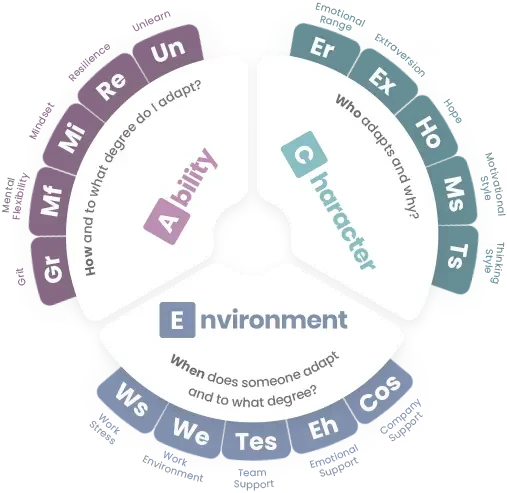
The ACE model behind AQ: Ability, Character and Environment.
What is an adaptability quotient assessment?
The adaptability quotient (AQ) is a measure of how effectively a person responds to change. An adaptability quotient assessment scores that response across fifteen dimensions. It also scores the workplace around the person, because context can help or hinder adaptability.
IQ measures reasoning ability, and EQ measures emotional awareness. AQ, by contrast, measures adaptability, and it treats adaptability as something people can develop. As AI keeps rewriting roles, that makes it a useful third lens beside IQ and EQ. Some buyers call it an adaptability quotient test, yet it has no pass mark.
The AQ Model® comes from AQai, built with Dr Nicholas Deuschel, a research professor at Carlos III University in Spain. First, it groups the fifteen dimensions into three. Also, Seven delivers the AQai assessment India's HR and business leaders use to see where to build adaptability.
The adaptability skills a person can build, such as grit, mental flexibility and resilience.
How a person is wired to meet change. These are preferences, so neither end of the scale is better.
What the workplace does to a person's capacity to adapt. Therefore a leader can change this part most directly.
Three situations that bring organisations to AQ
You are restructuring, and you do not yet know where people need support. Because this AQ test for organisations includes a team view, you can plan support before the announcement, not after the resistance.
Everyone has the new tools, yet use varies widely and nobody can say why. Then an adaptability assessment for leaders and teams shows whether the gap sits in skills such as unlearning, or in the conditions around the team.
Self-reports and behaviour often disagree. However, the AQ profile works as a leadership adaptability assessment India teams can act on: it gives the coach and the leader a specific starting point for the debrief, instead of a general chat about resilience.
Because AQme is a self-report instrument with no pass mark, we use it to inform development and change planning, not to screen or select candidates. For hiring, however, see our AI-based competency assessment.
The fifteen dimensions an adaptability quotient assessment scores
Each person receives a report across all fifteen, plus five advanced metrics, and both come from the same answers, so nothing extra is asked.
Swipe sideways to see the full model.

Ability
Skills you can build
Grit: Staying committed to long-term goals, so effort stays steady over time.
Mental Flexibility: Seeing tensions as choices and finding new routes when conditions shift.
Mindset: Beliefs about change, and whether effort can change outcomes.
Resilience: Recovering quickly from setbacks, then carrying on.
Unlearn: Deliberately letting go of outdated beliefs, so new habits can form.
Character
Preferences, no better or worse end
Emotional Range: How reactive or collected someone tends to be when under pressure at work.
Extraversion: The energy and enthusiasm someone brings when working with others.
Hope: Goal-directed energy, plus the ability to find another route when blocked.
Motivational Style: Whether protecting what you have or pursuing gains drives you more.
Thinking Style: The balance between big-picture and detailed thinking, since both help in change.
Environment
Conditions a leader can change
Company Support: Whether people feel valued and cared for by the organisation.
Emotional Health: Thriving at work, while positive emotions outweigh negative ones.
Team Support: Comfort in sharing knowledge, challenges and views, because that builds trust within the team.
Work Environment: Whether systems and rewards encourage experiments and treat failure as learning.
Work Stress: The sense of being overwhelmed by tasks, since too much stress limits adaptability.
Five advanced metrics, built on top of the fifteen
They show where readiness, learning appetite and uncertainty sit right now, but they are not forecasts, so a re-measure after a period of change shows what actually moved.
Change Readiness Index: How ready someone is to absorb change when it arrives.
Re-skill Index: Capacity to learn new skills as roles evolve, so it helps most when technology redesigns roles.
Explore and Transform: The pull towards new territory and radical innovation, rather than refining what exists.
Utilize and Improve: How far current strengths are used while improving what already works.
Change Uncertainty: How often someone feels unsure during change. Because it is scored in reverse, read it alongside the rest.
Dimension names follow AQai's published model, so read the full description on AQai's AQ Model page.
Change-readiness surveys versus measuring workforce adaptability
Most organisations already ask people how they feel about change, yet an adaptability quotient assessment measures whether people can do it.
AQ® and AQai® are registered trademarks of Adaptai Ltd, while Seven People Systems is an AQai certified practice in India.
Six deliverables in every adaptability quotient assessment
A conversational online assessment of about 22 minutes. Each person then receives a personal report across fifteen dimensions and five advanced metrics.
Every profile is debriefed one to one by a certified AQ coach, so the result becomes a development agenda.
When five or more people take it, results combine into one anonymised picture of where the team is strong, where it is stretched, and what the workplace is doing to both.
After we walk senior leaders through the team and organisation patterns, we agree together where support goes first.
Per person and per cohort, the roadmap names which Ability skills to train, which Character preferences to work with, and which Environment conditions leadership should change, so effort goes where it counts.
The same assessment after the intervention, with changes reported against the baseline. As a result, the improvement is shown, not assumed.
From baseline to built adaptability
Brief
We start with the change in front of you, such as a restructuring, an AI roll-out or a leadership programme. Then we shape the deployment and the debrief agenda around that decision.
Assess
Once each person completes AQme online in about 22 minutes, reports reach the practitioner before every debrief.
Debrief and map
First come one-to-one coaching debriefs. Then the AQteam view with leadership shows where adaptability is strong, where it is stretched, and what the environment is doing.
Develop and re-measure
Next, targeted development on the Ability skills that matter most, plus clear asks of leadership on Environment. After that, the re-measure shows what moved.
What changes for the individual, the leader, the team and the organisation
An adaptability quotient assessment earns its place when it changes decisions, seat by seat.
Because a low result on one dimension is a data point with a development path, not a flaw, people see which of their fifteen dimensions carry them and which need deliberate work.
While AQ profiling for executives shows each leader their own profile, adaptability testing for managers shows the sponsor which parts of the organisation can absorb the planned change. As a result, the plan can account for strain before the announcement.
Measuring team adaptability shows whether strain sits in work stress and emotional health, or in mindset and hope. Those are different problems, so they need different fixes.
When a company adaptability test combines results, they show where reskilling, leadership support or workplace change should come first. Also, a re-measure after the programme gives the board a before-and-after picture.
What the adaptability quotient assessment stands on
Workforce adaptability measurement should rest on published evidence, so we repeat AQai's evidence and its limits here. Then you can judge the instrument before you buy.
working adults in the global norm base
countries represented in that base
re-test correlation across the fifteen dimensions, where 1.0 is identical
What this gives you
- Each result appears against the norm base in low, medium and high bands, so there is no pass mark.
- Ability and Environment appear as bars, because they can move. Character appears on a continuum, because a preference has no better end.
- Then a re-assessment later shows what actually moved.
What it does not yet show
AQai states that criterion validity is not yet established. In other words, studies linking AQ results to later workplace outcomes are still to come.
AQme is also a self-report instrument, so it measures self-perception. For that reason, we frame every debrief as a conversation, not a verdict.
Figures as published by AQai on its AQ Model page.
Sample AQ reports and short films
Read a real adaptability quotient assessment report before you commit, since the samples open in a new tab and the films come from AQai.
Sample reports
Watch
At a glance
Talk to a practitioner
Tell us which people system is hurting — and get the answer the way an HR consulting firm in India should give it: from a senior practitioner, within one working day. No sales sequence, no juniors.
We use these details only to respond to your enquiry. We don't share them or add you to a mailing list. See our Privacy Policy.
The adaptability quotient assessment, asked straight
What is an adaptability quotient assessment?
An adaptability quotient assessment measures how effectively a person responds to change. Some people call it an adaptability quotient test, yet it has no pass mark. It scores fifteen dimensions across three areas, namely Ability, Character and Environment. Five advanced metrics, such as the Change Readiness Index, are built from the same answers. Because it also measures the workplace, the result shows where to build adaptability, not just who has it.
How is AQ different from IQ and EQ?
While IQ measures reasoning ability, EQ measures emotional awareness. AQ, however, measures adaptability, which is how effectively a person responds to change. IQ is relatively stable in adulthood, whereas the AQ model treats adaptability as developable and measures the person's environment alongside the person.
Can adaptability actually be improved?
Yes. Because the five Ability dimensions are learnable skills, and the five Environment dimensions describe conditions a leader can change, both can improve. Character is different, because those five dimensions are preferences that shift slowly. For that reason AQ is an assessment, not a personality test. The re-measure exists so that improvement is shown rather than assumed.
What does the adaptability quotient assessment feel like, and how long does it take?
The employee adaptability assessment India teams take lasts about 22 minutes online, in a conversational format, and there is no time limit or pass mark. Each person then receives a personal report across the fifteen dimensions and five advanced metrics. Finally, a certified practitioner debriefs every profile one to one.
Can we run an AQ test for organisations and teams?
Yes. When five or more people take it, an organisational AQ assessment combines individual results into the AQteam® view, which works as a company adaptability test India leaders can read quickly. Because the report is anonymised, nobody can identify an individual from it. The team view shows where adaptability is strong, where it is stretched, and what the workplace is doing to both. That is measuring workforce adaptability before a transformation, not after it. In short, an AQ test for organisations works best early. The same adaptability assessment for leaders then extends to managers and teams.
How reliable is the adaptability quotient assessment?
First, AQai publishes a norm base of 16,491 working adults from 141 countries, and a re-test correlation of .74 or higher across the fifteen dimensions. However, AQai also states that criterion validity is not yet established, so studies linking AQ results to later workplace outcomes are still planned. Also, AQme is self-report, which means it measures self-perception. Therefore we use it for development and change planning, not for selecting candidates. For hiring, however, see our AI-based competency assessment.
Who delivers the AQai assessment in India?
Seven People Systems is an AQai certified practice in India, so our AQ engagements are led by Nikhil Maini, an AQai practitioner India clients trust and a Top 10 AQai Coach. Also, the AQai assessment India teams take is the same global AQme® instrument, debriefed by a certified practitioner. AQai India clients therefore get one consistent method from the first profile to the re-measure.
How is the adaptability quotient assessment priced?
Pricing for the AQai assessment India clients buy is per person, and the practitioner debrief is included. Team deployments, meanwhile, bundle the AQteam® view and the leadership readout, while a re-measure is priced as a package with the baseline. We quote a fixed fee after the context brief, so there are no surprises later.
Measure adaptability before the next change tests it
Start with a context brief for your adaptability assessment for leaders and teams, because measuring workforce adaptability should begin with the change named first, the baseline second, and a certified debrief on every profile.


