
The DNA-25 competency assessment: 25 competencies, ranked by evidence
A DNA-25 competency assessment measures how developed a person is across 25 workplace competencies, then ranks them from most developed to least. Specifically, ours is the TTI Success Insights® DNA instrument, which groups the 25 into Thinking, Working and Relating. First we benchmark the role, then each person is assessed against it, and after that a certified analyst debriefs every report. As a result, development money goes where the payoff is highest.
19+ years · 600+ organisations · 23 sectors · Senior practitioners only, since 2007

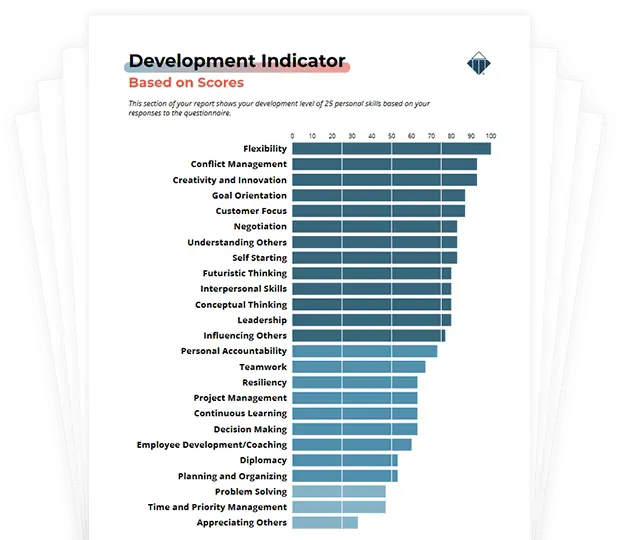
Sample pages from a TTI Success Insights® DNA report.
What is the DNA-25 competency assessment?
DNA-25, often written DNA25 or dna 25, is a validated instrument that measures a person's development level across 25 workplace competencies, from Problem Solving and Influencing Others to Resiliency and Futuristic Thinking. Then it ranks them into a competencies hierarchy, most developed to least, so the report tells you what to develop first.
A behavioural instrument such as DISC describes how someone naturally tends to behave. A competency assessment tool India organisations can compare people on asks a different question, namely how well developed is this specific skill right now, and what would improve it. Because competencies are skills, results can change with deliberate effort, whereas behavioural style changes slowly.
In fact, the TTI Success Insights DNA instrument was built to replace the forty-competency wishlists most homegrown frameworks become. Its design insight is simple, namely that the same 25 competencies apply to every role, and only the hierarchy changes. Therefore one framework serves the whole talent lifecycle, from hiring benchmark to succession bench. Also, Seven delivers the TTI DNA 25 assessment across India as a TTI partner, and we have never shipped a report without a debrief.
The hierarchy tells you what to develop first, while a list of scores never does.
Roles change the weighting, never the framework, so data compares across the whole organisation.
Competencies are trainable, so the report exists to aim the training where the payoff is highest.
Three situations that bring organisations to DNA-25
Names exist on the succession slide, yet evidence does not. So behavioural competency profiling with DNA-25 benchmarks the target role and shows precisely which candidates carry the competencies it demands, and which gaps are trainable before the seat opens.
Training spread evenly across everyone develops no one. Instead, a competency assessment tool India L&D teams can trust turns training-needs analysis into a ranked map of who needs what, and where the highest-payoff gaps sit, cohort by cohort.
Two candidates, two sponsors, no common evidence. However, a manager competency assessment puts both against the same benchmark and the same hierarchy, so the argument shrinks to what the data cannot settle.
Because DNA-25 reports current development level rather than a pass mark, we use it as one input inside a benchmarked process, never as a standalone hiring cutoff. TTI gives the same guidance. For role-specific selection evidence, however, see our AI-based competency assessment.
The 25 competencies a DNA-25 competency assessment scores
Every report scores and ranks all twenty-five, so this is the complete vocabulary of the framework, in TTI's three groups.
Thinking
Seven skills · analysis, creativity, learning and judgement
Working
Seven skills · execution, initiative and goal-directed action
Relating
Eleven skills · trust, connection and collaboration
How each competency is reported
First, each skill sits on its own scale from developed to needs development. Also, the report explains what the skill is, how it shows up at work, what others notice, and how to develop it. Because every person's 25 are then ranked into one hierarchy, the debrief starts at the bottom of the list that matters for the role.
Competency names and groups follow TTI Success Insights, so read the full description on TTI's DNA page.
The homegrown competency framework versus the instrument
Most organisations own a competency framework, yet very few own one that measures anything. So here is the difference, line by line.
Position benchmarking happens before assessment, so the role's hierarchy comes first and the people are measured against it second.
Six deliverables in every DNA-25 competency assessment
The role's own hierarchy comes first, namely which of the 25 competencies this position demands most, agreed with the stakeholders who own it.
Online and validated, per person. Then the DNA report generates with every competency scored and ranked into the hierarchy.
Every report is debriefed, because that conversation turns a hierarchy into a development agenda the person owns.
Person against benchmark, so you see which gaps matter for this role, which are trainable, and the plan aimed at the highest-payoff few.
For teams and programmes, individual hierarchies then aggregate into a cohort map, which becomes the honest basis for a training calendar.
Where the engagement calls for proof, the same instrument runs again later, so the change per competency is reported against the baseline.
From role benchmark to targeted development
Benchmark
We define the position's competency hierarchy with its stakeholders before anyone is assessed, so the data lands against a standard rather than an opinion.
Assess
The instrument runs online per person. Then the report generates with all 25 competencies scored and ranked into the hierarchy.
Debrief and map
First come the certified analyst debriefs, one per person. Next comes the gap map, which sets individual hierarchies against the role benchmark and shows cohort patterns for HR and L&D.
Develop and re-measure
Development is targeted at the highest-payoff gaps. After that, a re-assessment shows the change against baseline where the engagement calls for proof.
What changes for the individual, the manager, HR and the succession bench
A DNA-25 competency assessment earns its keep when it changes who gets developed, promoted and hired, so here is the change seat by seat. Also, this is where a 25 competencies assessment beats a framework on paper.
Not the generic curriculum, but rather their own hierarchy and their own highest-payoff gaps, debriefed into an agenda they recognise as true. So development stops being something done to people.
A manager competency test India organisations run shows, above all, which of the 25 carry a person and which drag. As a result, feedback, stretch assignments and coaching aim at named gaps instead of vague growth areas.
Cohort hierarchies show where capability genuinely thins. Because the L&D calendar is then built from measured gaps, the competency measurement tool Mumbai and Bengaluru teams have been guessing without finally does the aiming.
Candidates are measured against the target role's own hierarchy, so you see who is ready now, who is one trainable gap away, and who is miscast. In short, succession moves from names on a slide to evidence on the table.
Where DNA-25 gets applied
One framework, seventeen working applications, because the same 25 competencies can be re-weighted for the decision at hand.
Strategy and management
- Competency framework design, built on the 25 instead of a wishlist
- Engagement and motivation programmes aimed at measured gaps
- Planning and strategy alignment, because Creating Alignment is scored
- Change-readiness work, paired with AQ
- Culture and transformation work, alongside the OCI
- Outplacement with dignity and data
Training and development
- Leadership development targeting, since the hierarchy anchors our mid-level leadership accelerator
- Communication effectiveness
- Team effectiveness programmes
- Sales capability development
- Customer service training
- Coaching and mentoring relationships, so the hierarchy becomes the baseline
Hiring
- Position benchmarking before the search
- Recruitment and selection input, never a standalone cutoff
- Induction aimed at known gaps from day one
Personal
- Personal effectiveness planning
- Career planning against real strengths, for example through succession and talent reviews
What the TTI DNA 25 assessment stands on
The best competency assessment tools India can buy should rest on what the publisher actually claims, so we repeat TTI's position and its limits here. Then you can judge the instrument before you buy.
What this gives you
- Twenty-five named skills, each reported on its own scale from developed to needs development, rather than one number or a label.
- Technical documentation published openly by TTI's research team, as well as delivery in more than 100 countries.
- Comparable data across people, so an L&D leader can see, for example, that nine of twelve managers need Creating Alignment.
- Also, it pairs with other sciences. DNA tells you how developed a skill is, while DISC tells you how the person naturally behaves.
What it does not tell you
The instrument reports current development level as the person describes it, so it deserves a professional read. That is why every report is debriefed by a certified analyst who tests the pattern against role evidence, such as a 360 degree feedback round.
Also, it is not a pass or fail score, and TTI says it should never be used as a standalone hiring cutoff. For that reason we benchmark the role first and treat DNA-25 as one input inside a structured process.
Positions as published by TTI Success Insights on its DNA page and research site.
Sample DNA-25 reports and reference material
Read the real output before you commit. Each link opens in a new tab.
An authorized TTI DNA partner, with certified analysts on every debrief
Founder and MD, Seven People Systems
- TTI Success Insights partner, for DNA-25, DISC, 12 Driving Forces and EQ
- ICF Associate Certified Coach (ACC)
- AQai Certified Coach, recognised as a Top 10 AQai coach in India
Because Seven's DNA-25 engagements are led by Nikhil and delivered with certified analysts, every DNA-25 competency assessment we run is debriefed by a senior person, never a junior. Read more on Nikhil's profile.
DNA-25 is the competency baseline beneath our manager and leadership programmes. For example, it anchored assessment-led job benchmarking for more than 200 people at a healthcare chain. So see what changed, and for whom, in our client work.
Where we run it
The assessment is online, so location rarely limits you. Debriefs then run in person or by video, and a leadership competency assessment Mumbai cohorts book usually completes within two weeks. When teams want a wider picture, they often pair DNA-25 with DISC, EQ, AQ or TCQ™. Afterwards, leaders who want coaching on their profile can continue into executive coaching and C-suite advisory.
At a glance
Enquire about the DNA-25 competency assessment
Once you tell us which roles you are benchmarking, a certified analyst replies within one working day. Also, there is no sales sequence and no junior hand-off.
We use these details only to respond to your enquiry. We don't share them or add you to a mailing list. See our Privacy Policy.
The DNA-25 competency assessment, asked straight
What exactly does the DNA-25 report contain?
The report measures the person's development across 25 workplace competencies, which are grouped into Thinking, Working and Relating, and ranks them into a competencies hierarchy from most developed to least. Then, for each skill, it explains what the skill is, how it shows up at work, what others notice, and how to develop it. Also, every Seven deployment includes a certified analyst debrief, never a bare PDF.
What makes DNA-25 different from our own competency framework?
Your framework probably defines competencies, whereas DNA-25 measures them. TTI Success Insights built it to replace the forty-competency wishlists most homegrown models become, so the same 25 validated competencies apply to every role and only the hierarchy changes. That is what makes data comparable across the whole organisation, which a workshop-built framework can never guarantee. In short, it is the competency assessment tool India HR teams use when they need comparison, not just vocabulary.
Can we use DNA-25 in hiring?
Yes, as structured input, although never as a standalone verdict. The right sequence is position benchmarking first, so the role's own competency hierarchy is agreed before the search. Candidates are then assessed against that benchmark, and the gap map informs both selection and, for the person hired, an induction plan aimed at known gaps from day one. For role-specific selection evidence, see our AI-based competency assessment.
How is the competencies hierarchy determined, and can people game it?
The hierarchy reflects the individual's responses to a validated instrument, which are then ranked by measured development level. Like any self-report tool it deserves a professional read, which is exactly why every report is debriefed by a certified analyst. During the debrief the analyst probes the pattern, tests it against role evidence, and turns behavioural competency profiling into a development conversation rather than a self-portrait.
Does DNA-25 work for teams, or only individuals?
Both. Individual hierarchies aggregate into cohort maps, so they show where a team's collective capability is deep, where it thins, and which gaps are shared versus personal. For HR and L&D, therefore, that cohort view is the honest basis for a training calendar. For leaders, meanwhile, it shows what the team can and cannot yet carry. In other words, a TTI DNA 25 assessment works for individuals and cohorts alike.
Is DNA-25 the right manager competency assessment for first-time and mid-level managers?
Yes, and it is the baseline beneath our manager programmes for that reason. A manager competency assessment built on the 25 shows a new manager, for example, that Problem Solving is developed while Creating Alignment and Employee Development and Coaching need work, which is a classic contributor-to-manager profile. Then the programme and the coaching aim at those named gaps, and a re-measure shows what moved.
How does DNA-25 differ from DISC and from a 360?
DISC describes how a person naturally behaves, whereas DNA-25 measures how developed 25 specific skills are right now. A 360 adds what others observe. Because they answer different questions, they are often combined. DNA-25 pairs with DISC in TTI's TriMetrix DNA report, and we read it alongside a 360 round when the engagement needs observed evidence.
How is the DNA-25 competency assessment priced?
Pricing is per assessment, and the analyst debrief is always included. Position benchmarking is scoped per role, while cohort deployments carry volume pricing with the gap-map readout bundled. We quote a fixed fee after the context brief, so you know the full cost before a single link is sent.
Benchmark the role. Measure the people. Develop what pays.
Start with a context brief, because a DNA-25 competency assessment should begin with the roles named first, the benchmark second, and a certified debrief on every single report.