
The Organizational Culture Inventory®: the culture you actually run, measured
The Organizational Culture Inventory measures the behavioural norms people believe are expected of them, which is the culture that operates, not the one on the values poster. Specifically, ours is the Human Synergistics® OCI, which maps those norms onto the Circumplex across twelve styles in three clusters. First leadership defines the ideal culture, then the organisation measures the current one, and after that an accredited practitioner reads the gap with you. As a result, culture change starts from evidence.
19+ years · 600+ organisations · 23 sectors · Senior practitioners only, since 2007
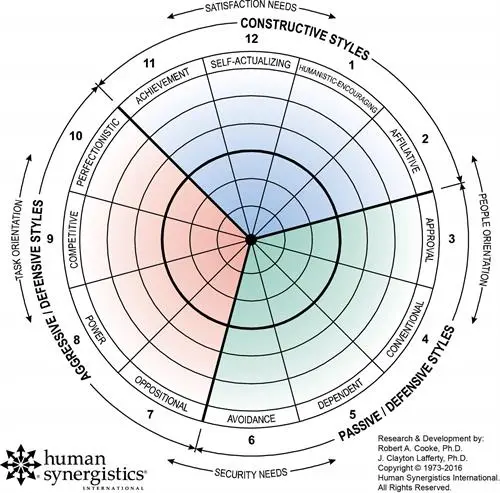
The Human Synergistics® Circumplex: twelve styles, three clusters.
What is the Organizational Culture Inventory?
The Organizational Culture Inventory measures culture at its operating level, namely the behavioural norms members believe are expected of them in order to fit in and get ahead. Responses aggregate onto the Human Synergistics Circumplex across twelve styles in three clusters, so you see the culture as it runs, not as it is described.
Engagement surveys measure how people feel, whereas the OCI culture inventory measures what people believe is expected, which is a different thing. Because norms drive daily behaviour whether or not anyone is happy about it, this is the culture assessment tool for companies that want to change behaviour rather than mood. It is also the culture assessment tool for companies planning a merger or a transformation.
Developed by Robert A. Cooke and J. Clayton Lafferty, and refined over more than 35 years of research, the Human Synergistics OCI comes in two forms. The OCI-Ideal captures the culture leaders and members believe the strategy requires, while the standard OCI measures the culture people actually experience. Therefore the gap between the two profiles is the change agenda, drawn by the organisation's own data. Also, Seven delivers the organisational culture inventory India wide through Human Synergistics accredited practitioners.
Achievement, Self-Actualizing, Humanistic-Encouraging and Affiliative. These are the norms that research links to performance, satisfaction and retention, so they are the target.
Approval, Conventional, Dependent and Avoidance. In these cultures, fitting in quietly outranks doing the right thing, because safety comes from people.
Oppositional, Power, Competitive and Perfectionistic. These cultures run on internal contest, so energy burns inward.
Three situations that bring organisations to the OCI
The stated values say collaboration and ownership, yet the operating reality rewards approval-seeking and blame avoidance. Leadership suspects it. However, an OCI assessment India boards can rely on proves it, with the organisation's own aggregated data.
A transformation is being planned, whether strategic, digital or structural, and nobody has measured whether the current culture can carry it. So the OCI baselines readiness before the announcement, not after the resistance.
Two organisations, two sets of unwritten rules, yet one integration timeline. Because both cultures are measured on the same Circumplex, the softest integration risk becomes comparable, discussable evidence.
The OCI is the measurement. When the gap becomes a change programme, that work runs through our culture change management practice, and this page stays focused on the instrument.
The twelve styles an Organizational Culture Inventory profile shows
Every OCI survey circumplex profile reports all twelve styles, and the OCI survey circumplex is the same for Ideal and current, so here is the complete vocabulary, in Human Synergistics' three clusters.
Constructive
Norms that support effectiveness
Achievement: Members are expected to set challenging goals, then pursue them with enthusiasm.
Self-Actualizing: Members are expected to grow, enjoy their work and, above all, take on new activities.
Humanistic-Encouraging: Members are expected to be supportive, constructive and, equally, open to influence.
Affiliative: Members are expected to be friendly, cooperative and, in particular, sensitive to the group.
Passive/Defensive
Norms that protect security through people
Approval: Members are expected to agree with others, so they gain approval and are liked.
Conventional: Members are expected to conform, follow the rules and, in short, make a good impression.
Dependent: Members are expected to do what they are told and, likewise, clear all decisions with superiors.
Avoidance: Members are expected to shift responsibility, so they avoid any possibility of blame.
Aggressive/Defensive
Norms that protect status through tasks
Oppositional: Members are expected to be critical and oppose ideas, so decisions are safe yet ineffective.
Power: Members are expected to take charge and control subordinates, while yielding to superiors.
Competitive: Members are expected to operate in a win-lose framework, hence to outperform peers.
Perfectionistic: Members are expected to avoid mistakes, keep track of everything and, consequently, work long hours.
Why three clusters, not one score
Human Synergistics reports the three sets of norms separately, because they are distinct and their effect on effectiveness is cumulative. Also, the clusters sit on one Circumplex, so a culture can be strongly Constructive and still carry a Perfectionistic streak that eats the calendar. Reading them together is what makes real culture change feasible.
Style names and cluster definitions follow Human Synergistics, so read the full description on the Human Synergistics OCI page. Also, OCI® and the Circumplex are registered marks of Human Synergistics International.
The OCI Circumplex, style by style
Hover over any of the twelve styles, or tap one on a phone, and the card shows the norm it describes. Because the Organizational Culture Inventory profiles your organisation on exactly this model, this is the map every readout is drawn on.
Achievement
Style 11 of 12Members are expected to set challenging but realistic goals and solve problems effectively.
Hover or tap a style on the wheel to read its norm.
Circumplex®, style names and norm definitions © Human Synergistics International, research and development by Robert A. Cooke, Ph.D. and J. Clayton Lafferty, Ph.D. Reproduced by Seven People Systems as an accredited practitioner. Read the original on the Human Synergistics OCI page.
The engagement survey versus the culture inventory
Engagement tells you how people feel, whereas culture decides how they behave when nobody is watching. So the instruments are not interchangeable.
Run both and they answer different questions, deliberately. Keep the engagement survey, then add the instrument that explains it.
Six deliverables in every Organizational Culture Inventory deployment
First, leadership and key members define the culture the strategy requires. Because it is measured on the Circumplex, it is not asserted in a workshop.
The organisation-wide survey of operating norms, which is what people actually believe is expected, aggregated and mapped onto the same Circumplex.
Ideal against current, style by style, so you see where the culture supports the strategy, where it quietly works against it, and how far the distance is.
Findings are interpreted with leadership and the change team by an accredited practitioner, so the OCI is never delivered as a report drop.
Paired with the OEI, the levers behind the norms, namely structures, systems and skills, come into view. As a result, the change agenda targets causes rather than symptoms.
The OCI runs again down the line on the same instrument, so culture movement is demonstrated rather than asserted.
From ideal culture to measured change
Define the Ideal
The OCI-Ideal runs with leadership and key members first, so the culture the strategy requires is on the Circumplex before anyone measures reality.
Measure the current culture
Next, the standard OCI surveys the organisation, confidentially and in about 20 minutes per person. Then responses are aggregated into the current-culture profile across all twelve styles.
Read the gap
Next comes the accredited practitioner readout with leadership. The two profiles sit side by side, the priority gaps are named, and the conversation the values poster never starts finally happens.
Act and re-measure
The gap becomes the change agenda. After that, the OCI runs again down the line, so culture movement is demonstrated on the same instrument that found the problem.
What changes for leadership, HR, teams and the change programme itself
A culture measurement pays for itself the day the conversation changes, so here is the change seat by seat.
The Circumplex gives the board and the CXO team what culture talk never had, namely a shared model, a measured baseline, a defined target and a gap. So culture stops being an adjective in the annual report and starts being managed like the strategic asset it is.
As a result, the culture case stops resting on anecdotes and exit interviews. Instead, HR walks into the room with the best culture assessment tools India can license, which is the culture assessment tool for companies with a board to convince, and with norms maintained by Human Synergistics behind every claim.
People finally see the norms they have been navigating by instinct, for example why approval-seeking beats candour here, or why perfectionism eats the calendar. Naming the pattern is the first act of changing it.
Whatever the change, whether strategy, merger or digital, it lands on culture. Because an OCI deployment India wide baselines first, you see whether the culture can carry it, what must shift for it to stick and, later, whether it did.
Where the OCI gets applied
One instrument, eight high-stakes contexts. The same Circumplex, aimed at different decisions.
The measured before-state every serious culture programme needs, and the re-measure that proves it worked. Our culture change management work starts here, with an OCI assessment India wide or unit by unit.
Both cultures on one Circumplex before the operating models merge, so the softest integration risk becomes comparable.
Whether the current norms can carry the planned transformation, answered before the announcement, often alongside AQ.
When execution keeps stalling despite capable people, the OCI shows whether the norms reward what the strategy needs.
Because the OCI-Ideal is measured, it forces the top team to agree on the culture they are actually asking for.
The normative causes beneath the sentiment scores, so you learn why engagement reads the way it does.
Where defensive norms suppress bad news, quality and safety pay for it. Then the OCI finds the suppression.
Culture measured on the same instrument, year over year, so boards finally get a trend line they can read.
What the Human Synergistics OCI stands on
An organisational culture measurement tool should rest on what the publisher actually claims, so we repeat Human Synergistics' position and its limits here. Then you can judge the instrument before you buy.
What this gives you
- More than 35 years of research, as well as reliability and validity assessed by Human Synergistics and by dozens of independent researchers, with over a hundred books, journal articles and dissertations on the inventory.
- Culture measured as norms, which is what is expected, and values, which is what should be expected, rather than attitudes, which belong to climate.
- Three clusters reported separately on one Circumplex, so the picture reflects real organisational dynamics instead of a single culture index.
- Also, it pairs with the OEI, which measures the outcomes of the culture and the levers that can change it.
What it does not tell you
The OCI measures norms, not individuals. Results are aggregated, so nobody is singled out, and the profile describes the organisation or unit rather than any one person.
It also does not explain why the norms exist. For that reason, Human Synergistics recommends running it in tandem with the OEI, and every readout is debriefed by an accredited practitioner rather than read off a dashboard.
Positions as published by Human Synergistics on its OCI page and product information sheet.
OCI downloads and case studies
Read the licensor's own documentation before you commit. Also, each link opens in a new tab on the Human Synergistics site.
A Human Synergistics accredited partner India leaders have worked with since 2007
Founder and MD, Seven People Systems
- Human Synergistics accredited practice, for the OCI, OEI and GSI
- ICF Associate Certified Coach (ACC)
- TTI Success Insights partner and AQai Certified Coach
Because Seven's OCI engagements are led by Nikhil and delivered with accredited practitioners, every Organizational Culture Inventory readout is debriefed by a senior person, never a junior. Read more on Nikhil's profile.
The OCI is the diagnostic beneath our culture and transformation engagements, so see what changed, and for whom, in our client work.
Where we run it
The survey is online, so location rarely limits you. Readouts then run in person or by video, and a twelve-styles culture survey Delhi NCR or Pune organisations commission usually completes within four weeks. When leaders want a wider picture, they often pair the OCI with the OEI, the GSI for intact teams, or Lens360 AI™ for individual leaders. Afterwards, the change programme itself runs through our culture and employee experience practice.
At a glance
Enquire about the Organizational Culture Inventory
Once you tell us what your culture is costing you, an accredited practitioner replies within one working day. Also, there is no sales sequence and no junior hand-off.
We use these details only to respond to your enquiry. We don't share them or add you to a mailing list. See our Privacy Policy.
The Organizational Culture Inventory, asked straight
What does the Organizational Culture Inventory actually measure?
First, it measures behavioural norms, which is what members of the organisation believe is expected of them in order to fit in and succeed. That is a deliberately different question from how people feel, because norms drive daily behaviour whether or not anyone is happy about it. Responses aggregate onto the Human Synergistics Circumplex across twelve styles in three clusters, namely Constructive, Passive/Defensive and Aggressive/Defensive.
How is the OCI different from our engagement survey?
They answer different questions. Engagement measures sentiment, such as satisfaction, advocacy and intent to stay. The OCI, by contrast, measures the operating culture producing that sentiment, which is the norms people navigate every day. Most organisations that run both discover the engagement score was a symptom, while the Circumplex profile is the cause. So keep the engagement survey, and add the instrument that explains it.
What is the OCI-Ideal, and why measure it?
In short, it is the same instrument pointed at the target state. Leadership and key members describe the culture the strategy actually requires, and it lands on the Circumplex as a measured profile. As a result, it does two things nothing else in culture work does. First, it forces the top team to agree on what they are asking for. Second, it turns culture change from an aspiration into a measurable gap between two profiles.
Who takes the OCI survey, and how long does it take?
Typically a representative sample or the full organisation takes the standard OCI, while the leadership and key-member group takes the OCI-Ideal. Each survey takes about 20 minutes online, and responses are aggregated so that no individual is ever singled out. That confidentiality is precisely why people answer honestly, so the OCI survey circumplex profile is a reliable picture.
Is the Organizational Culture Inventory valid and reliable?
Yes. In fact, Human Synergistics describes it as the most widely used and thoroughly researched culture assessment available, and its reliability and validity have been assessed by Human Synergistics and by dozens of independent researchers. Also, it measures norms and values rather than attitudes, which is what separates a culture inventory from a climate or engagement survey.
What happens after the OCI results come in?
First, an accredited practitioner works the findings with leadership and the change team. The two Circumplex profiles sit side by side, the priority gaps are named, and the causal question is opened, namely which structures, systems and skills are producing these norms. That question is answered by the OCI's companion instrument, the OEI, and together the pair turn measurement into a change agenda. When that agenda becomes a programme, it runs through our culture change management practice.
Who delivers the Human Synergistics OCI in India?
Human Synergistics licenses the OCI only to accredited practitioners, and Seven People Systems is a Human Synergistics accredited partner India organisations have used since 2007. So the OCI assessment India clients commission through us is the same global instrument, debriefed by an accredited practitioner, with norms maintained by the licensor.
How is the OCI priced?
Pricing follows deployment scope, namely population size, Ideal plus current, and the depth of the leadership readout. Licensor survey fees are passed through transparently, and the accredited debrief is always included. We quote a fixed fee after the context brief, so the full cost is known before a single survey link goes out.
Measure the culture you actually run
Start with a context brief, because an Organizational Culture Inventory deployment should begin with the strategic question named first, the Ideal defined second, and an accredited debrief on every readout.