DISC assessment India trusts for hiring, teams and the conversations in between
A DISC assessment India organisations can act on measures how people actually behave at work, across Dominance, Influence, Steadiness and Compliance. Specifically, ours is the TTI Success Insights® instrument, which scores every factor twice, natural and adapted, in 15 to 20 minutes online. Then a certified practitioner debriefs every report. After that, the profile goes to work in hiring, team design and coaching, instead of sitting in a drawer.
19+ years · 600+ organisations · 23 sectors · Senior practitioners only, since 2007
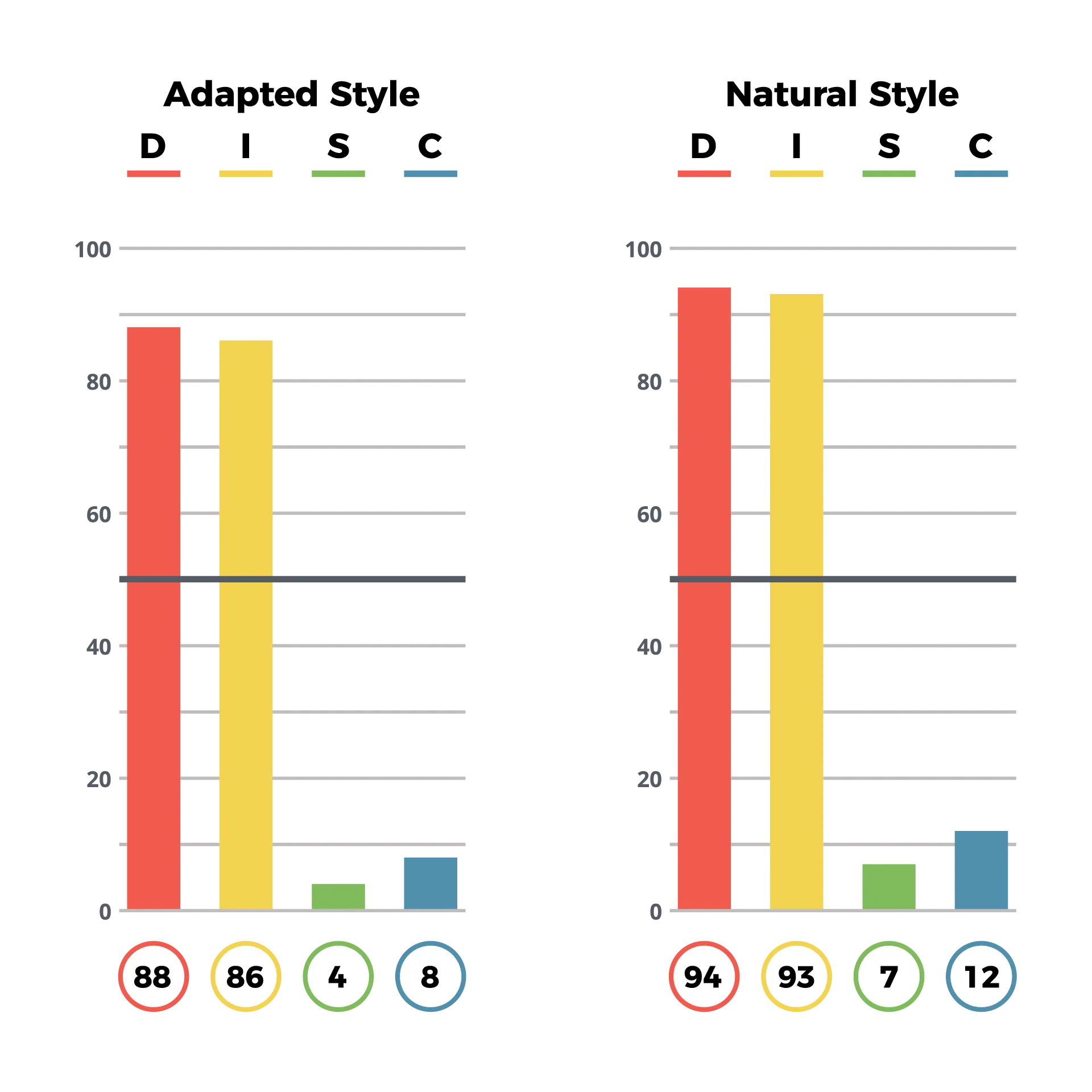
Natural and adapted style graphs, as in a TTI Success Insights® report.
What is a DISC assessment?
A DISC assessment India organisations use is a behavioural instrument that measures how a person prefers to act, communicate and make decisions, at work and beyond. It is not a personality, intelligence or mental health test, because it measures what people actually do. That is why a DISC behavioural assessment travels so well into hiring, teaming and coaching.
The DISC model itself is public, so dozens of publishers sell a DISC personality test for workplace use, and the free quiz and the instrument share only the four letters. What separates the TTI DISC assessment is that it scores every factor twice, your natural style and your adapted style, and reads the gap between them. That gap is where sustained adaptation costs energy, and it is also where blind spots form.
TTI Success Insights has published and validated DISC instruments since 1984, in more than 100 countries, and it publishes its technical research openly. Seven is a TTI Success Insights partner, so the DISC test Mumbai, Bengaluru and Delhi NCR teams take through us is the same validated instrument, debriefed by certified practitioners. Also, we use TTI's terms: D is Dominance, I is Influence, S is Steadiness and C is Compliance.

How a person responds to problems and challenges. High-D styles, for example, are direct, decisive and comfortable with risk.
How a person influences others. High-I styles, for instance, are persuasive, enthusiastic and think out loud.
How a person responds to pace and change. High-S styles, in turn, are patient, consistent and anchor the team.
How a person responds to rules and procedure. High-C styles are accurate, process-minded and verify before acting.
Three situations that bring organisations to DISC
Capable people, real friction, and the conflict is behavioural rather than motivational. Then DISC profiling for teams gives everyone a neutral, evidence-based language for why the friction exists and exactly how to bridge it.
Interviews run on instinct, so the misses are expensive. The Interviewing Insights version grounds each conversation in structured, profile-specific behavioural questions, so there is data where gut feel used to be.
Coaching stalls without an honest starting point. However, a debriefed DISC profile shows a leader their natural style, their adapted mask, and precisely where the two are pulling apart under pressure.
Because DISC measures self-reported behavioural preference, not job performance, we use it as an input to hiring and never as a verdict. TTI gives the same guidance. For role-specific selection evidence, however, see our AI-based competency assessment.
What a DISC assessment India report from TTI actually contains
The letters are shared across the industry, yet the instrument is not. So here is what the TTI DISC assessment India clients receive actually scores, and how a debrief uses each part.
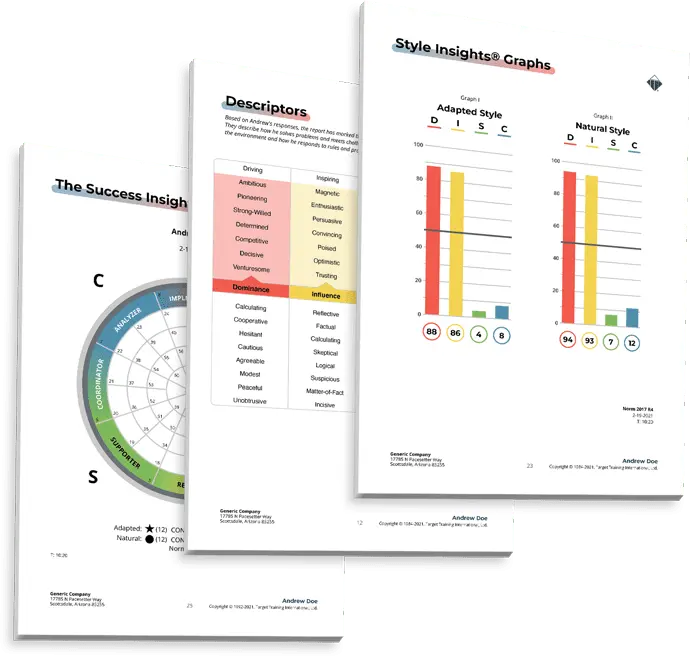
The two graphs
Every factor, scored twice
Natural style graph: Behaviour when a person is not consciously adjusting, so it shows default reactions under pressure. The debrief uses it for coaching.
Adapted style graph: Behaviour the person displays in their work role, in other words the professional self. Because it shows where they are spending energy adapting, it diagnoses role-fit friction.
The gap: The distance between the two graphs. A wide gap on one factor usually means sustained strain, so that is where development starts.
The working sections
What managers and teams use daily
Communication do's and don'ts: Specific guidance on how to reach this person, which managers then use in one-to-ones and hand-offs.
Ideal environment: The conditions under which this style thrives, so team design and the first 90 days of onboarding start from evidence.
Behavioural hierarchy and style wheel: Where this person sits among the combinations of all four factors, rather than a single dominant letter.
If you know Everything DiSC
TTI labels the fourth factor Compliance, while some other publishers call it Conscientiousness. The construct is the same, namely response to rules and procedure. However, TTI scores all four factors at both ends of the scale and interprets combinations, which is why the report runs deeper than a four-letter type.
Report sections and factor definitions follow TTI Success Insights, so read the full description on TTI's DISC assessment page.
The free DISC quiz versus a TTI DISC assessment
The letters look the same, yet almost nothing underneath them is. So here is the difference, line by line.
Style Insights®, Talent Insights®, TriMetrix® and 12 Driving Forces® are trademarks of TTI Success Insights, while Seven People Systems is a TTI partner in India.
Every DISC assessment report version, and which decision each one serves
One instrument, eleven report versions. The behavioural data behind every DISC assessment India version is the same, so you choose the version that matches the decision in front of you, and then we debrief it.
Core and role versions
The foundation report, with natural and adapted graphs first, then the behavioural hierarchy, communication do's and don'ts, ideal environment and the style wheel.
Download the sample PDF →The core report written for managers and their teams, so it adds sections on managing, motivating and communicating with this person.
Request this sample →The same behavioural data read through the sales cycle, namely prospecting, presenting, handling objections and closing in this person's style.
Request this sample →For service and support roles, because it shows how this person handles customers, pressure and escalation, with coaching notes for the manager.
Request this sample →Written for senior leaders, since a board-level debrief needs different language and depth.
Request this sample →Structured, profile-specific behavioural interview questions, so interviews probe evidence instead of instinct.
Request this sample →The team wheel and behavioural map for a whole cohort, so you see who drives, who withdraws, and where the friction actually comes from.
Request this sample →Multi-science versions
DISC plus 12 Driving Forces®, so you see how a person behaves and what drives them in one report.
Request this sample →DISC, 12 Driving Forces and emotional intelligence together, for coaching and leadership development.
Request this sample →DISC, 12 Driving Forces and 25 competencies together, which is the stack behind our leadership and succession work.
Request this sample →DISC, 12 Driving Forces, competencies and acumen, which is the fullest picture TTI offers for senior selection and development.
Request this sample →Sample PDFs are published by TTI Success Insights, and each one opens in a new tab. For versions marked "request", tell us the role in the enquiry form and we send the matching sample within one working day.
Six deliverables in every DISC assessment India engagement
Online and mobile friendly, so it takes 15 to 20 minutes per person. Then every factor is scored twice, and the report version you chose generates immediately.
Every report, every time. Because the debrief is a coaching conversation, it turns behavioural insight into development priorities rather than a report walkthrough.
For cohorts, DISC profiling for teams aggregates into the team wheel and is worked live, so communication gaps are named and operating agreements designed.
Before candidates are assessed, we benchmark the role, so the DISC behavioural assessment is compared with what the job needs rather than a generic ideal.
DISC pairs with 12 Driving Forces® and DNA-25 into one picture, namely how people behave, what drives them and what they can do.
Coaching check-ins, application assignments and a formal review, because behavioural change is a programme, not an event.
What changes for the individual, the leader, the team and the hiring panel
A DISC assessment India teams actually use pays for itself in fewer misreads, so here is the change seat by seat.
People see their own two graphs, for instance where they hold back at work and what that costs. Then they get communication guidance matched to the colleagues they actually work with.
A corporate DISC personality assessment, as many buyers still call it, shows a leader the gap between natural and adapted style. As a result, coaching starts from evidence rather than feedback folklore.
Team DISC profiling India facilitators use shows, above all, who drives, who withdraws and where the styles collide. Because the team sees its own wheel, the operating agreements come from the team, not the consultant.
With a job benchmark first and the Interviewing Insights version in the room, DISC test for employees Hyderabad or Pune recruiters run becomes structured questioning. So the instrument informs judgement without replacing it.
Where DISC assessment India engagements get applied
One instrument, eight contexts. The same four factors, aimed at different decisions.
Benchmark the role first, then assess candidates against it, so behavioural fit is evidence rather than instinct.
Map style distribution across a team to find gaps and overlaps, which is also the diagnostic behind our leadership retreats.
Reduce avoidable friction between working styles, because the do's and don'ts are specific to each person.
The Sales version reads the same data through the sales cycle, so coaching lands on how each person actually sells.
A DISC personality profile at work gives new managers a language for their team, which is why our first-time manager programme baselines it.
Compare candidates with the behavioural demands of the next role, alongside the competency view from talent management and succession planning.
The Customer Service version shows how each person handles customers, pressure and, finally, escalation.
A measured starting point for any coaching engagement, then the adapted graph as the progress evidence. Also, a DISC personality test for workplace coaching reads better than a type label.
The evidence behind the TTI DISC assessment
The best DISC behavioural assessment India can buy should rest on what the publisher actually claims, so we repeat TTI's position and its limits here. Then you can judge the instrument before you buy.
What this gives you
- Instruments published and validated since 1984, used in more than 100 countries, with technical documentation published openly on TTI's research site.
- Every factor scored at both ends of the scale, while natural and adapted behaviour are presented as two separate graphs.
- A forced-choice design whose validation methods are patented, so the usual criticism of ipsative DISC tools has a documented answer.
- Also, it pairs with other sciences. DISC tells you how a person behaves, while EQ tells you whether they can read a situation and adjust.
What it does not tell you
DISC is a reliable measure of self-reported behavioural preference, yet not of job performance. In other words, a DISC behaviour test for organisations describes style, not results. Used alone, it does not predict how well someone will do a job, and TTI says so itself.
For that reason, we never screen candidates in or out on a DISC score. Instead, we benchmark the role first and pair the profile with role-specific evidence, such as a 360 degree feedback round or a competency assessment.
Positions as published by TTI Success Insights on its DISC assessment page and research site.
An authorized TTI DISC partner Mumbai teams have worked with since 2007
Founder and MD, Seven People Systems
- TTI Success Insights partner, for DISC, 12 Driving Forces, EQ and DNA-25
- ICF Associate Certified Coach (ACC)
- AQai Certified Coach, recognised as a Top 10 AQai coach in India
Because Seven's DISC engagements are led by Nikhil and delivered with certified practitioners, every TTI Style Insights assessment we run is debriefed by a senior person, never a junior. Read more on Nikhil's profile.
Our DISC assessment India work sits inside a wider body of leadership, culture and performance engagements, including DISC-based change work with a 65-person risk and compliance team at a housing finance company. So see what changed, and for whom, in our client work.
Where we run it
The assessment is online, so location rarely limits you. Debriefs then run in person or by video, and a DISC team workshop Mumbai or Bengaluru teams book usually runs in a single day. When teams want a wider picture, they often pair DISC with EQ, AQ, Lens360 AI™ or TCQ™. Afterwards, leaders who want coaching on their profile can continue into executive coaching and C-suite advisory.
At a glance
Enquire about the DISC assessment
Once you tell us what you need DISC for, a certified practitioner replies within one working day with the matching report version and a sample. Also, there is no sales sequence and no junior hand-off.
We use these details only to respond to your enquiry. We don't share them or add you to a mailing list. See our Privacy Policy.
The DISC assessment India buyers ask about, answered straight
Is DISC a personality test?
Strictly, no, and the distinction matters. In fact, most people searching for a DISC personality test for workplace use are looking for exactly this instrument. However, DISC measures observable behaviour, which is what people do, rather than personality traits, intelligence or mental health. That is precisely why a workplace DISC personality test India HR teams run is safe and practical, because behaviour can be discussed, adapted and coached without labelling anyone.
What makes the TTI DISC assessment different from the free versions online?
Three things. First, it measures each factor twice, natural and adapted style, and reads the gap. Second, it sits on instruments validated since 1984, with published research and maintained norms. Third, it never arrives as a bare PDF, because every report is debriefed by a certified practitioner. The free quiz gives you a letter, while the TTI Success Insights DISC India organisations buy through a partner gives you a defensible development conversation.
Can we use DISC for hiring decisions?
As an input, yes, although never as a verdict. We benchmark the role first, then use the Interviewing Insights version to generate structured, profile-specific behavioural questions, so interviews probe evidence instead of instinct. What we will not support is screening candidates out on a DISC score alone, because DISC does not predict job performance by itself. For selection evidence, see our AI-based competency assessment.
How is DISC different from MBTI?
MBTI sorts people into sixteen preference types, whereas DISC measures graded intensity across four observable behavioural factors. Also, the TTI version measures how you adapt under work pressure, which type indicators do not attempt. For workplace application, such as hiring conversations, coaching and team design, behaviour beats type, because behaviour is what colleagues actually experience.
What does DISC profiling for teams look like?
Individual profiles come first, completed before anyone meets. Then the practitioner builds the team wheel, which is the collective behavioural map, and facilitates a working session where the team sees its own pattern. Then, during that session, the team names its communication gaps and designs operating agreements against them. Because team DISC mapping shows real dynamics, facilitation addresses what is actually happening rather than what is assumed.
Which DISC report version should we choose?
Choose by the decision. Management-Staff suits managers and their teams, Sales and Customer Service suit those roles, Executive suits senior leaders, and Interviewing Insights suits hiring. The Team report serves cohorts, while Talent Insights and the TriMetrix versions add driving forces, EQ or competencies. If you are unsure, tell us the situation, after which we recommend the version and send a sample.
How long does a DISC behavioural assessment take, and is it accurate?
The DISC assessment India teams take lasts 15 to 20 minutes online, with no time limit and no pass mark. It is accurate as a measure of self-reported behavioural preference, since TTI publishes its reliability and validity documentation openly. However, it is not a predictor of job performance on its own, which is why every result is debriefed and, for hiring, paired with role-specific evidence.
How is the DISC assessment priced?
Pricing is per profile, and the debrief and report version are always included. Team deployments, meanwhile, bundle the team wheel and the workshop, while volume pricing applies at cohort scale. Bundled pricing also applies when DISC is stacked with EQ and DNA-25. We quote a fixed fee after the context brief, so the full cost is known before a single link is sent.
Measure behaviour before you hire, team or coach on it
Start with a context brief, because a DISC assessment India leaders can act on should begin with the decision named first, the right report version second, and a certified debrief on every single profile.