How to Use AI in Healthcare to Improve Diagnosis Accuracy and Reduce Administrative Burden
- April 28, 2026
- Posted by: info@seven.net.in
- Category: AI Certification
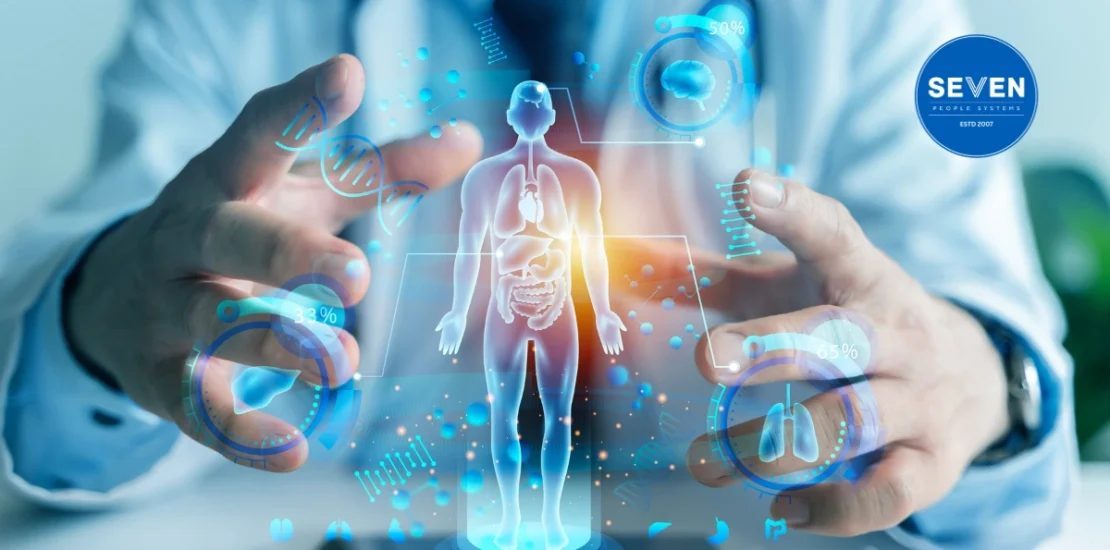
The potential to use AI in healthcare to improve diagnosis accuracy is no longer a distant ambition — it is happening right now in hospitals, clinics, and diagnostic centres across India. At the same time, reducing the administrative burden in hospitals with AI is freeing clinical staff to focus on what truly matters: patient care. With AI-powered clinical decision support in India expanding rapidly, and healthcare data management using AI becoming a core hospital competency, the demand for skilled professionals is surging. For doctors, administrators, and health IT leaders across Mumbai, Delhi, Bengaluru, Hyderabad, and Pune, an AI Healthcare certification in India is the clearest path to leading this change with confidence.
Key Takeaways
- AI in healthcare to improve diagnosis accuracy is transforming India’s medical sector by enhancing diagnostic precision and reducing administrative burdens.
- AI processes medical data at unprecedented speeds, identifying patterns that human clinicians might miss.
- Hospitals are using AI in imaging, predictive analytics, and natural language processing to improve patient care and efficiency.
- To implement AI, organizations must audit data infrastructure, select compliant tools, and ensure staff training and support.
- The AI+ Healthcare certification prepares healthcare professionals to lead AI adoption and drive impactful changes in patient outcomes.
Revolutionize Patient Care with Advanced AI
Self-paced course + Official exam + Digital badge
Why AI in Healthcare Is Transforming India’s Medical Sector
India’s healthcare system faces a uniquely intense set of pressures. With over 1.4 billion people, a doctor-to-patient ratio far below the WHO recommendation, and rapidly growing chronic disease burden, the need for scalable, intelligent solutions is urgent.
AI addresses this challenge directly. It processes medical data at a speed and scale no human team can match. It identifies patterns in imaging, lab results, and patient histories that even experienced clinicians can miss. Furthermore, it handles repetitive administrative tasks — scheduling, billing, documentation — that currently consume up to 40% of a clinician’s working day.
Hospitals across AIIMS Delhi, Apollo Mumbai, and Manipal Bengaluru are already piloting AI-assisted diagnostic tools. Consequently, the gap between early adopters and the rest of India’s healthcare sector is widening every month.
How AI Improves Diagnosis Accuracy in Clinical Settings
Diagnostic errors are among the most costly problems in healthcare — both in human and financial terms. AI tackles this challenge through several proven mechanisms.
Medical Imaging and Radiology
AI models trained on millions of medical images can detect anomalies in X-rays, MRIs, CT scans, and pathology slides with remarkable precision. In fact, several studies show AI matching or exceeding specialist-level accuracy in detecting conditions like diabetic retinopathy, tuberculosis, and early-stage cancers.
For diagnostic centres in Hyderabad and Pune managing high patient volumes, AI-assisted imaging reduces turnaround time significantly while maintaining — and often improving — diagnostic quality.
Predictive Analytics for Early Intervention
Beyond imaging, AI analyses patient history, vitals, lab trends, and demographic data to flag patients at risk of deterioration before a crisis occurs. Moreover, predictive models in ICU settings across Indian hospitals are already reducing sepsis mortality by identifying early warning signs hours before traditional methods would.
Natural Language Processing for Clinical Notes
AI-powered NLP tools read unstructured clinical notes and extract structured, actionable insights. Therefore, physicians receive synthesised summaries of patient history, drug interactions, and diagnosis-relevant data — without spending hours manually reviewing records.
How AI Reduces Administrative Burden in Hospitals
Reducing administrative burden in hospitals with AI has become a strategic priority for healthcare leaders across Mumbai, Delhi, Bengaluru, and Hyderabad — and the results are already measurable.
Administrative overhead is one of the biggest inefficiencies in healthcare. Billing errors, appointment mismanagement, redundant documentation, and insurance claim processing drain resources that should go towards patient care. AI solves each of these systematically.Ultimately, reducing administrative burden in hospitals with AI delivers a double benefit — lower operational costs and more time for clinical staff to focus on patients.
Intelligent Appointment Scheduling
Reducing administrative burden in hospitals with AI starts with one of its most visible wins — intelligent appointment scheduling that eliminates manual booking errors entirely. AI scheduling systems analyse patient demand, doctor availability, and historical no-show patterns to optimise appointment allocation in real time. Additionally, automated reminders and rescheduling workflows reduce no-show rates by up to 30% in pilot programmes across Indian private hospitals.
Automated Medical Coding and Billing
Medical coding is time-consuming and error-prone. AI tools now read clinical documentation and automatically assign the correct ICD codes, reducing billing errors, accelerating insurance claim submissions, and cutting denial rates. Hospitals in Mumbai and Delhi processing thousands of claims monthly are achieving significant cost savings through this automation.
AI-Powered Documentation and Discharge Summaries
Physicians spend a disproportionate amount of time on documentation. AI ambient listening tools — already in use at select tertiary care centres in Bengaluru — transcribe doctor-patient conversations in real time and generate structured clinical notes automatically. As a result, doctors reclaim hours every week for direct patient care.
Healthcare Data Management Using AI: A Strategic Priority
Data is the foundation of every AI application in healthcare. However, India’s healthcare sector still grapples with fragmented, siloed, and often paper-based records. Consequently, healthcare data management using AI is not just a technical upgrade — it is a strategic necessity.
Building an AI-Ready Data Infrastructure
For AI to deliver value, hospitals need clean, structured, interoperable data. This means transitioning fully to electronic health records (EHRs), standardising data formats, and implementing data governance frameworks aligned with India’s Digital Personal Data Protection (DPDP) Act 2023.
Federated Learning for Privacy-Safe AI
One of the most promising developments in Indian healthcare AI is federated learning — a technique that trains AI models across multiple hospital datasets without centralising patient data. Therefore, hospitals can collaborate on AI model development while maintaining full patient data privacy and regulatory compliance.
Real-Time Analytics for Hospital Operations
Beyond clinical applications, AI analyses operational data — bed occupancy, OT scheduling, pharmacy inventory, and staff deployment — to optimise hospital resource utilisation in real time. Hospitals in Hyderabad and Pune using these systems report measurable improvements in both patient experience and operational efficiency.
AI-Powered Clinical Decision Support: What It Means for Indian Doctors
AI-powered clinical decision support is therefore not a luxury for large hospital chains it is a practical necessity for every clinical team managing high patient volumes across India’s metro cities.
For doctors in busy outpatient departments across Delhi and Mumbai — often seeing 60 to 80 patients a day — a well-designed CDSS is the difference between a rushed decision and an informed one. Furthermore, CDSS tools integrated with EHR systems reduce prescription errors, improve treatment adherence, and generate audit trails that support clinical governance.
Revolutionize Patient Care with Advanced AI
Self-paced course + Official exam + Digital badge
Key Sectors Within Indian Healthcare Benefiting From AI Right Now
AI adoption is not uniform across Indian healthcare. Currently, the highest-impact applications are concentrated in:
- Radiology and pathology — AI-assisted image analysis in diagnostic chains
- Oncology — early cancer detection through pattern recognition in imaging and genomics
- Cardiology — ECG interpretation and cardiac risk prediction using AI models
- Mental health — NLP-driven screening tools identifying depression and anxiety markers in patient interactions
- Rural and tier-2 healthcare — AI diagnostic tools extending specialist-level care to underserved regions beyond metro cities
Importantly, the National Health Policy of India explicitly supports AI integration as a mechanism to bridge the urban-rural healthcare divide — making this a nationally prioritised growth area.
HOW-TO BLOCK
How to Implement AI in a Healthcare Setting to Improve Outcomes
- Audit your data infrastructure
assess EHR completeness, data quality, and interoperability readiness before deploying any AI tool.
- Start with high-impact, low-risk use cases
medical imaging analysis and appointment scheduling deliver fast, measurable ROI with minimal clinical risk
- Select DPDP-compliant AI tools
ensure every vendor meets India’s Digital Personal Data Protection Act 2023 requirements.
- Integrate AI with existing clinical workflows
deploy CDSS tools within your EHR system so clinicians access AI insights without switching platforms.
- Train clinical and administrative staff
AI adoption fails without user confidence; invest in structured onboarding and change management.
- Establish a governance framework
define who reviews AI recommendations, how errors are reported, and how models are monitored post-deployment.
- Measure outcomes continuously
track diagnostic accuracy, admin time saved, claim denial rates, and patient satisfaction scores
- Scale what works
start with one department, prove value, then expand systematically across the organisation.
Lead AI Adoption in Healthcare with AI+ Healthcare Certification
Every application covered in this guide — diagnostic AI, clinical decision support, healthcare data management, administrative automation — is a core module inside the AI+ Healthcare certification at Seven People Systems. This programme is purpose-built for healthcare professionals, hospital administrators, health IT leads, and clinical informaticists across India who want to drive AI adoption with competence and confidence.
📄 Download the AI+ Healthcare Course Flyer (PDF) to explore the full curriculum, eligibility, and certification pathway.
Want to strengthen your technical AI foundation? Explore our AI+ Engineer™ certification for production AI pipeline architecture skills that complement your healthcare domain expertise.
Whether you are based in Mumbai, Delhi, Bengaluru, Hyderabad, or Pune — the healthcare AI revolution is already underway. This certification ensures you lead it rather than follow it.
👉 Enroll in AI+ Healthcare Certification Today →
Latest Post
- How to Drive Organizational Culture Change That Actually Sticks
- How to Ensure Your AI Systems Stay Compliant With Global Data Privacy Regulations
- How to Use AI in Finance Without Compromising Accuracy, Compliance, or Your Judgment
- How to Build AI-Powered Dashboards That Give Decision-Makers Real Answers, Not Just Data
- How to Use AI to Automate QA Testing and Catch Defects Before They Reach Customers
Revolutionize Patient Care with Advanced AI
Self-paced course + Official exam + Digital badge